
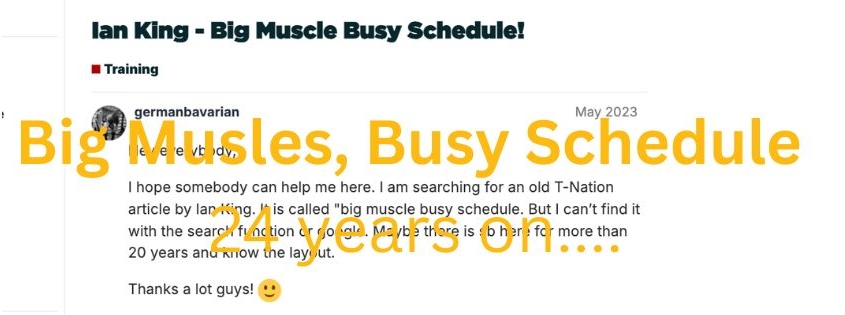

Big Muscles, Busy Schedules – 24 years on…
Recently I received this question about an article i wrote nearly a quarter of a century ago. It was a great question and deserved a great answer. I share it with you and trust you find value in this exchange.
“I’ve been training for almost 16 years now, but with the demands of becoming a licensed psychotherapist, running my own practice, and having a family, time has become pretty limited. “Big Muscles, Busy Schedules” was exactly the kind of two-day-per-week program I’d been looking for—so thank you for that!
I do have a question though: looking back after 24 years, would you make any changes to the program today? For instance, Stage 6 doesn’t include shoulder work, and after Stage 1 there aren’t any direct arm exercises. Considering the more recent insights from hypertrophy research—especially from people like Chris Beardsley—would you add or modify any movements, maybe include some isolation work?
Thanks so much for your time, and for all the great work you’ve done over the years!–Jacob, DE
Jacob – thank you for reaching out and great to hear you have found value in my article/program. I fully understand the added challenges of study, work, family etc. on one’s training. This is exactly what much of my ‘Get Buffed!’ writing is for, and I quote from my Get Buffed! book: “For the average drug free-got a job/go to school person, I recommend consider using…”
As to your questions, let’s get into it:
“Looking back after 24 years, would you make any changes to the program today?”
Absolutely there may be changes – but they may not be what you think or expect. Allow me to explain – I have written very few generic programs, relatively speaking. I have actually avoided writing generic programs for the first 20 years of my coaching, and it was only from 2000 that I realized the need to write a few. I have always, and I stress always, individualized programs for athletes. Very individual.
So, the challenge I have with generic programs is the way they are interpreted. They are general examples. They are not really written for an individual per se, and ideally once the value is found in them by the end user,I would prefer they take advantage of my extensive efforts through tools including but not liited to the current Get Buffed! four book sequel and shape these programs at least a little for themselves. As the Taoist saying goes regarding the fish and the fishing basket: “
The fish trap exists because of the fish. Once you’ve gotten the fish, you can forget the trap. The rabbit snare exists because of the rabbit. Once you’ve gotten the rabbit, you can forget the snare. Words exist because of meaning. Once you’ve gotten the meaning, you can forget the words. Where can I find a man who has forgotten words so I can talk with him?”
So, I would prefer an end user who finds value in my generic programs move on, forget the generic program in the literal sense, and shape it to their needs.
In summary, I have some degree of embarrassment and concern about writing generic programs, for the fear many will be stuck on the program, and not the message. They are not, and cannot be, designed for anyone, as they are composites of imagination as to who the end user might be.
Hopefully this is not too deep or esoteric. I just wanted to express my reservations when asked to provide generic programs. Despite the number of generic programs that I have written for end user and coach education, I have only once in sport at the representative level provided a generic program, and that was a reflection of the budget, and a realization that what I might write may be better than what they would otherwise receive.
Now let’s go deeper on your question, breaking it up into bite size pieces:
“For instance, Stage 6 doesn’t include shoulder work…”
There is absolutely a time and place to remove any given muscle group, but that decision hopefully is individualized! So I would write that again in a program, 24 later, under appropriate circumstances. Are those your circumstances? I don’t know – that is why I have a dissonance with generic programs…
“…and after Stage 1 there aren’t any direct arm exercises…”
There is absolutely a time and place to remove any given muscle group, and I do it more times than you might imagine. In particular with athletes – there are relatively few (and note I said relatively few) competitive sports that require or benefit from an over-focus on arm size. Yes, I know, this is contrary to dominant trends. It’s akin to bench pressing in alpine skiing. The focus on the chest in the last decade or so – in particular in a country with 50 or so states…. – is insane. And the rise in torn biceps in athletes is also insane. And ironically, most athletes who tear their biceps did so in the pursuit of upper arm strength and size in excess of what I consider optimal for their sport. But what would I know? I have only been at this for 45 years…
There are no shortage of individuals (and I refer mainly to non-athletes) whose arm development gives the casual observer the impression they are huge – but a closer review reveals a trunk that is not much bigger than the arms…
It all comes back to what you are chasing. And some just want the instant gratification of arm isolation programs and that a life-style choice. I am not knocking it – I just want to put arm training in context.
“Considering the more recent insights from hypertrophy research…”
Now that opens up a whole new can of worms. A few points:
• ‘Research’, and I assume you mean from a ‘recognized academic institution’, is what is allowed to be selected as a study topic and published.
• I take a different approach to research – I consider it involves objective analysis as the primary requirement, not something that is the exclusive domain of the ‘ivory tower’.
• Historic analysis of ‘research’ influence on strength training provides an ‘interesting’ insight into the mandate of being ‘research compliant’. For example, through the 1970s and early 1980sif you did heavy loaded exercises (what we now call maximal strength training) you were engaging in dangerous and high risk of injury activity. The use of free weights was painted with the same brush. If you engaged in squats (the double leg bent knee type), you were stretching the ligaments of the knee and you should not squat. The lower back EMG studies showed little to no activity past a certain degree of flexion (they omitted to place the electrodes on any other muscles involved including the hamstrings…) and therefore you should not engage in forward flexion such as a deadlift. I could go on.
• ‘Research’ for the most part does not answer long term questions such as what should I do today that will optimize my training outcome in 40 year’s time.
So no, I am not ‘research compliant’. I wasn’t when the article and program was written in 2002, and I am still not now. Does that mean I am divisive of ‘research’? Not at all. I just take it with a grain of salt, except when I find a person is the average of the dozen or so undergraduate students and their long term goal is the 8 weeks duration of the study…(Yes, I am being facetious.)
To take this one step further, I seek to provide what the late US thinker Buckminster-Fuller is credited with calling ‘generalized principles. The aim is to provide guidance that does not need massive tweaking every tie there is a ‘trend’ or ‘research’ change. Which is why we are still talking about this program 24 years later….
“…would you add or modify any movements…?”
I may well do, but I would prefer to provide those tweaks on the basis of knowing more about the end user. I read a few years back in one of those ‘secret’ titled books about program design that a ‘fitness professional’ knows 80% of what they need to know before meeting the client, and only an additional 20% is gained upon meeting them. What a load of BS! Did this ‘author’ actually believe this, or was is a shot at an impressive marketing line? If they did believe it, God help their clients…
We can be better than this. And you, the client, deserve better that this.
‘Research’ or that ‘80%’ learnt by the ‘fitness professional’ does not answer questions such as:
• What is your age and gender?
• What is your maturation and aging status?
• How many hours a week do you work at your job? • Is your job blue (manual) or white (more sedentary) collar?
• How much stress is involved in your job?
• How long does it take you to travel to and from work?
• How many days a week do you work from home?
• How are your personal relationships going, including with any significant other?
• How many kids do you have?
• How old are your kids?
• What is your training history?
• What is your injury history?
• What equipment do you prefer to train on?
• What exercises do you prefer to do?
• What training methods do you prefer to do?
• What training equipment do you prefer to use?
• What results have you got from your training?
• What is the temperature, humidity, altitude and air quality where you live and train?
• What is the water quality, amount and frequency that you consume?
• What about your diet and nutritional supplements?
• What about your past and present medications
• What other health conditions are you at risk or suffer from?
• What is your personality and emotional status and how does this impact your choice of training location?
• What time of day do you get the best results from training? Listen, I am just warming up. But I hope you get the hint. ‘Research’ does not have those answers, and good luck if you believe your ‘fitness professional’ has 80% of all they need to know to program you before you even meet them….
In conclusion, it takes all types to shape our world. Some want a free or cheap program that will meet a lot of their needs. Other will want a bit of help, some with their motivation, or accountability, others with some more superficial guidance. When I fully individualize training program for an athlete or client, ideally with the prospect of being involved in a primary role of a decade or two, I take all the time I need to match the program variables to the individual. My generic programs are great, and in some cases may be better than what some may provide you in their best interpretation of an ‘individualized’ programs. But when comparing apples to apples, my individualized programs, or you tweaking my generic programs relying on the education I have provided in books and articles during the last five decades, is better.
