

The Wallabies Kiwi experiment
In 2008 the Australian Rugby Union (ARU) employed a non-Australian to coach the national men’s team for the first time, making Australia possibly the first Tier 1 rugby nation in the professional era to do so. This coach was Robbie Deans from New Zealand. It was a move some called brave, but either way it raised eyebrows. Since then, the ARU has seen fit to engage two more foreign coaches, also from New Zealand. To date, our southern hemisphere rivals New Zealand and South Africa have not followed in this path.
Since 2008, New Zealand coaches have held Australian men’s national coaching positions for a combined eleven (11 years) of the last eighteen (18) years, or 61% of the years. Suffice to say they have been the dominant influence on the direction of the men’s national rugby team over the last two decades.
There is more than sufficient data to review the ARU’s decision to look overseas, and in particular to New Zealand, for coaching guidance. Keep in mind that this decision has broader impacts than the scoreboard. It also reflects values around coach development and impacts opportunities for domestic coaches.
A statistical analysis of the Wallabies Kiwi coaches
The following is a statistical analysis of the Australian men’s national team coaches that hail from New Zealand. The analysis focuses on
Robert Deans [1]
Robert Deans coached the Australian national men’s team during the period 2008 to 2013, or six (6) seasons. His win loss record with the Wallabies was 58.7%, making him the most successful of the three New Zealand coaches to coach Australia. [2] He also holds the record for the most tests coached by an Australin men’s national coach at 75 tests.
Against his former nation the All Blacks, Deans was 3 games out of 18 (17%).[3]
During his six-year tenure as the Wallabies national coach, Deans did not win a Bledisloe Cup during (0%), won one Rugby Championship (17%), and placed third in the only World Cup he presided over (0%).When Deans was appointed as the men’s national coach in December 2007, Australia’s international rugby ranking was 5th, and in the month of his resignation (July 2013) it was 3rd. [4]
Dave Rennie [5]
Dave Rennie coached the Australian national men’s team during the period 2020 to 2022, or three (3) seasons. His win loss record with the Wallabies was 36.4%, making him the least successful of the three New Zealand coaches to coach Australia. [6]
Against his former nation the All Blacks, Rennie was 1 game out of 7 (14%).[7]
During his three-year tenure as the Wallabies national coach, Rennie did not win a Bledisloe Cup during (0%), or Rugby Championship (0%), and did not preside over a World Cup (-%).When Rennie was appointed as the men’s national coach in November 2019 Australia’s international rugby ranking was 5th, and in the month of he left the role (January 2023) it was 6th. [8]
Joe Schmidt [9]
Joe Schmidt coached the Australian national men’s team during the period 2024 to 2025, or two (2) seasons. His win loss record with the Wallabies was 39.3%, making him the second least successful of the three New Zealand coaches to coach Australia.[10]
Against his former nation the All Blacks, Rennie was 0 game out of 4 (0%).[11]
During his two-year tenure as the Wallabies national coach, Schmidt did not win a Bledisloe Cup during (0%), or a Rugby Championship (0%), and did not preside over a World Cup (-%).
When Schmidt was appointed as the men’s national coach in January 2024 Australia’s international rugby ranking was 9th, and in the month of he left the role (mid 2026) it was 8th. [12]
Table 1 – Summary of success of the Australian Rugby’s New Zealand Coaches.
| Coach |
Win-Loss Record [13] |
Cup Results [14] |
World Rugby Rank |
|||||||||
|
# Yrs |
P | W | L | D | % | Bled [15] | RC | RWC | Start | Finish | Change | |
|
Dean |
6 | 75 | 44 | 29 | 2 | 58.7% | 17% | 1 | 0 | 5th | 3rd |
+2 |
| Rennie |
3 |
33 | 12 | 18 | 3 | 36.4% | 14% | 0 | n/a | 5th | 6th |
-1 |
| Schmidt * |
2 |
28 | 12 | 19 | 0 | 38.7% | 0% | 0 | n/a | 9th | 8th |
+1 |
| AVERAGE * |
3.7 |
45 | 22 | 21 | 2 | 44.6% | 10% |
|
||||
* Updated 31 July 2026
A statistical analysis of the Wallabies Australian coaches
The following table summarizes the win-loss record of the Wallabies Australian coaches during the ‘professional era’.[16]
Table 2 – A summary of the win-loss record of the Wallabies Australian coaches during the ‘professional era’. [17]
| Years | Wallaby Coach | W-L %age |
| 1997-2001 | Rod Macqueen | 79% |
| 2001-2005 | Eddie Jones | 58% |
| 2006-2007 | John Connolly | 64% |
| 2013-2014 | Ewen McKenzie | 59% |
| 2014-2019 | Michael Cheika | 50% |
| 2023-2023 | Eddie Jones | 22% |
| Averages | 55.3% |
The average of the six (6) Australian coaches of the Wallabies during this period was 55.3%
A comparison between the Wallabies New Zealand and Australian Coaches
The following table compares the win-loss record of the Wallabies Australian coaches during the ‘professional era with the win-loss record of the Wallabies New Zealand coaches during the same era.
Table 3 – Comparison of the Wallabies Australian coaches during the ‘professional era with the win-loss record of the Wallabies New Zealand coaches during the ‘professional era’.
|
Origin of Coaches |
W-L %age |
|
Wallabies New Zealand coaches |
44.8% |
| Wallabies Australian coaches |
55.3% |
The verdict is in
With the completion of three coaching contracts in review, we have the results to form an comparative analysis of the decision by the Australian Rugby Union to select foreign coaches, and exclusively New Zealand coaches.
The New Zealand coaches average win-loss record is 44.6%, 11% lower than the 55.3% average for the Australian coaches.
A bigger picture look
To understand the role of the dominant New Zealand coaching influence in Australian national men’s coaching during the last twenty years, we can wider the lens and take a bigger picture look at the on-field results of the Wallabies since the game went ‘professional’ in 1996, thirty (30) years ago.
The following table and graph combine all Wallaby coaches’ performances during the professional era to date.
Table 4 – The combined chronological results of all Wallabies coaches during the ‘professional era’.
|
Years |
Wallaby Coach |
W-L %age |
|
1997-2001 |
Rod Macqueen |
79% |
|
2001-2005 |
Eddie Jones |
58% |
|
2006-2007 |
John Connolly |
64% |
|
2008-2013 |
Robbie Deans |
59% |
|
2013-2014 |
Ewen McKenzie |
59% |
|
2014-2019 |
Michael Cheika |
50% |
|
2020-2023 |
Dave Rennie | 36% |
| 2023-2023 | Eddie Jones |
22% |
| 2024-2025 | Joe Schmidt |
39% |
The data in this table is expressed in the graph below.
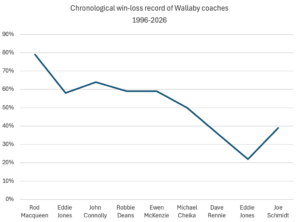
Figure 1 – The combined chronological results of all Wallabies coaches during the ‘professional era’.
It is reasonable to suggest there is a linear decline in win-loss records over the last thirty years, and origin of the coach does not appear to the cause of that trajectory.
Conclusion
The aim of this article is to compare the results achieved by foreign coaches hired by the Australian Rugby Union to the results achieved by domestic coaches. The data suggests that the New Zealand coaches results are lower than the Australian coaches results, specifically in the win-loss record.
It is also important to note that the aim of this statistical analysis was to review the decision by the Australian Rugby Union to select foreign coaches, and exclusively New Zealand coaches. It is not to judge the coaching ability of the coaches involved, rather to look at the results during their time in Australia, in the Australian social, political and physical environment.
These coaches have all experienced greater success before arriving in Australia, and also afterward, for those coaches who have continued to coach.
The point was raised earlier that there may be broader implications for Australian rugby than the on-field results. For example, the lost opportunities and lack of focus on domestic coaches and coaching development, to name one.
Since turning ‘professional’, Australian rugby during the last thirty years has slipped from number two (2nd) in international rankings to as low as tenth (10th), currently sitting in 8th. [18]
It is reasonable to conclude or suggest that the Australian Rugby Union has turned to arguably the greatest rugby nation in the world, New Zealand, for coaches in the hope to reverse this decline. It’s also reasonable to conclude is has not worked.
Some might say that the graph turning up recently is a positive sign. Getting excited about raising from 22% to 29% win-loss is questionable.
The question remains – if it’s not the coaches, what is the cause of this downward trajectory?
References
[1] https://en.wikipedia.org/wiki/Robbie_Deans
[2] https://en.wikipedia.org/wiki/Australia_national_rugby_union_team_coaches
[3] https://en.wikipedia.org/wiki/Bledisloe_Cup
[4] https://commons.wikimedia.org/wiki/Data:Men%27s_World_Rugby_rankings.tab
[5] https://en.wikipedia.org/wiki/Dave_Rennie
[6] https://en.wikipedia.org/wiki/Australia_national_rugby_union_team_coaches
[7] https://en.wikipedia.org/wiki/Bledisloe_Cup
[8] https://commons.wikimedia.org/wiki/Data:Men%27s_World_Rugby_rankings.tab
[9] https://en.wikipedia.org/wiki/Joe_Schmidt_(rugby_union)
[10] https://en.wikipedia.org/wiki/Joe_Schmidt_(rugby_union)
[11] https://en.wikipedia.org/wiki/Bledisloe_Cup
[12] https://commons.wikimedia.org/wiki/Data:Men%27s_World_Rugby_rankings.tab
[13] https://en.wikipedia.org/wiki/Australia_national_rugby_union_team_coaches
[14] https://en.wikipedia.org/wiki/The_Rugby_Championship
[15] https://en.wikipedia.org/wiki/Bledisloe_Cup
[16] https://en.wikipedia.org/wiki/Australia_national_rugby_union_team_coaches
[17] https://en.wikipedia.org/wiki/Australia_national_rugby_union_team_coaches
[18] https://commons.wikimedia.org/wiki/Data:Men%27s_World_Rugby_rankings.tab

