
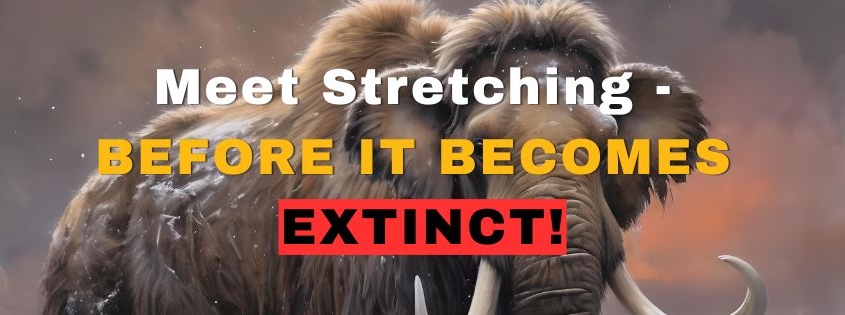

Meet stretching – before it becomes extinct
When I stayed at Mammoth Mountain in California for the first time in the 1990s with a Canadian national team for a training camp three things stood out to me about the venue. First that it was warm enough almost for t-shirt but yet there was snow. Secondly, that you could ski and surf in the same day such was the proximity of these slopes to the beach. And thirdly, the bronze monument of the Mammoth.
I was intrigued by the beauty of an animal that no longer existed in that region. Like many animals, they had become extinct. Based on the rate of suppression and decline in take up rate post the mid-1990s, I suggest flexibility training or stretching as it is often called is at risk of the same fate – extinction.
Here’s a bit of history from my observations over the last half a century to support this concern.
The 1970s
The 1970s was big decade for stretching. The American physical educator Bob Anderson and his wife Jean self-published their first edition of the book titled Stretching. It was a small spiral bound edition, full of great guidance and driven by what I believe was a genuine intent to serve the world. It was picked up by more established publishing houses in 1980 and this helped spread the world globally.
Personally, it was where my stretching journey began:
My personal history in stretching goes back to the 1970s, in my high school years. During track and field amongst other sports I was exposed to stretching. I do not recall any negative connotations or concerns in that decade towards stretching or flexibility training. I suspect doing stretches would not have turned anyone’s head in that decade. [1]
I was the product of the 1970s, and I was the product of track and field and martial arts, both of which were sports leaders in the embracement of flexibility. So, I had a reasonably high level of personal involvement, commitment and competence in this physical quality. [2]
In the late 1970s my exposure to martial arts also began, and stretching was integral to that sport in that era.
I sum-up the 1970s approach to stretching in this way –
You did it or you didn’t do it – no-one cared
I liked the days in the 70s when no one really cared, no one even talked about it; we just did it, and no one had an opinion on that; they did or you didn’t do it. And since then, every decade, we’ve gone through a new reason why not. [3]
The 1980s
The impact of iconic books such as the Anderson’s Stretching book grew during the 1980s thanks to broader publication and distribution channels. Stretching was simply part of what so many sports did.
In the 1980s during university, I participated in a variety of sports, some of which – such as martial arts – promoted flexibility training as paramount. [4]
I feel it’s reasonable to say that stretching was gaining momentum on the upside during the 1980s.
I took this value into my competitive training and competing in other sports in the second half of the 1980s – competitive powerlifting and weightlifting, rugby union etc. I noticed people looked, some asked questions, but no-one really cared. [5]
The other factor that in hindsight stands out to me about this decade was the lack of resistance. I was gaining traction as a coach and consultant in strength training – and my approach was to take stretching along for the ride as a non-negotiable partner to my strength training services. And I had zero push-back.
I was further unique, in that I chose to bring flexibility training along with strength training. From the early1980s, I would not provide strength training – either in program design or in supervision of training – without concurrent flexibility training. That was my starting point. Length and strength. [6]
I was doing it with athletes in all sports. I was doing it with up to 20 different sports at the elite level during the late 80s and 90s. And no one really objected to it. No one said anything. No one complained. The coaches probably struggled a little bit because I was eating into their time, and that’s a story in itself. But, in essence, my conclusions were shaped by the athlete’s response, their performance and injury prevention response to my application. And I formed a number of hypotheses during the late 80s, in particular, about the relationship between stretching and injury prevention.
And I implemented them, and I studied the results, you know, in the real-world laboratory sense, in particular throughout the early 90s, when I gained a lot more control in the training process. [7]
To reiterate – I was hired to provide strength training and I gave that, and stretching, as a pair of services. The latter was not asked for, but no-one said no or objected. Quite the contrary – what I was doing in stretching was often received as more unique.
I sum-up the 1980s approach to stretching in this way –
No-one gave a rat’s ass
When I was teaching stretching in the 80s, … no one gave a rat’s ass. No one really cared. [8]
The 1980s built on the ambivalence of the 1970s towards stretching with an increased involvement in the training method.
The 1990s
The 1990s began where the 1980s had left off, and for the first half of that decade my approach of bringing stretching along for the ride did not experience any pushback.
And by the mid-90s, I formed an incredibly effective approach to flexibility, and I formed, by then, the solid belief that flexibility is the most important physical quality, and the physical quality that will have more impact upon all other physical qualities, and also on the quality of life going forwards. [9]
And then, by around 1995, I sensed a change, a new negativity to stretching.
And after 15 years of doing it, by the mid-90s, something had happened. What was that? Suddenly I learned of a new theory. Stretching was bad. [10]
The 2000s
By the turn of the century this anti-stretching sentiment had momentum.
By the late 1990s/early 2000’s the stretching paradigm was that static stretching had an acute (short-term) impact of reducing your strength, so if you want to do it, only do it afterward the workout. This paradigm suggested more dynamic or PNF (i.e. proprio-neuromuscular facilitation, a special mix of static and dynamic stretching) type stretching should be done before the workout, but again only short duration holds were apparently needed. [11]
What were the proposed reasons for the shift against stretching?
I noted three stages of negativity against stretching during the last half of a century.
The first was pushing back on the increased support for stretching being a way of reducing injuries.
My first exposure to negativity to stretching was in the late 1980s. This resistance to stretching was in the form of ‘stretching has not been proven to prevent injuries’. Essentially it was based on short-term studies suggesting that groups that stretched did not have a lower incidence of acute injuries than groups that did not stretch. This completely overlooked the long-term impact of stretching and its role in preventing use or chronic injuries.
It was not what I would call a strong pushback, and it failed to gain a lot of momentum. You could say this reason to stretch is still hanging around in the background. [12]
The second reason that was subsequently proposed was that stretching created a risk of injuries through hypermobility.
In the late 1980’s and early 1990’s I witnessed the rise of a paradigm that suggested you shouldn’t stretch too much because if you got too flexible, you would be injury prone i.e. your increased flexibility would result in a higher incidence or chance of being injured. [13]
And the third reason that was subsequently proposed – and I conclude the first two were not achieving the goals of suppressing stretching – was that stretching (especially pre-training stretching) made you ‘weak’.
By the late 1990s/early 2000’s the stretching paradigm was that static stretching had an acute (short-term) impact of reducing your strength, so if you want to do it, only do it afterward the workout. This paradigm suggested more dynamic or PNF (i.e. proprio-neuromuscular facilitation, a special mix of static and dynamic stretching) type stretching should be done before the workout, but again only short duration holds were apparently needed. [14]
What do I think was the real reason behind this shift against stretching?
Quite simply, I believe the rise in popularity of stretching through the last three decades of the 20th century presented a problem to some, to which they found a solution – crush it. After all, it worked for the car industry to slow the emergence of electric cars![15]
In the 60s when I was training, nobody really did it. In the 70s when I started doing it in high school, no one really cared. In the early 80s when I was doing it in a professional training environment, people would ask, oh that’s interesting. No one really cared. Guess what? When it became so popular and the sports scientists decided that they needed to exert their influence to control the situation, what was the first thing they said? You can’t do it until we decide why you want to do it. And they’re still deciding. [16]
I suggest that as stretching gained in support throughout the 1980s and into the 1990s alarm bells were ringing. The attitude of ‘we will prove it wrong until we approve it’ was evident from academia.
In the late 1980s I took my professional skills to North America. I noticed that my commitment to stretching was significantly more than what my Canadian and American counterparts were doing.[17]
I sensed a feeling of resentment at the practitioner level that athletes were getting exposed to the benefits of stretching at time when strength / strength and conditioning cohort had no personal or professional knowledge of, belief in and skills of stretching.
So, what was happening on the coach front? At least one-third of the successfully self-marketed ‘strength coaches’ in the US market do not train at all. However, 100% of them do not stretch, have never stretched, and would be made a fool of if the interest in and demand for stretching was to continue to rise as it was in the early 1990s. [18]
Many if not all of my colleagues have never stretched, cannot touch their toes, and therefore from an ego protection perspective the last thing they will allow is the rise of a training value that makes them look bad.[19]
This was where I felt the resistance first.
At a second level, and a few years later, the academics were what I suggest recruited to stem the tide of interest in stretching.
The academics had the power of ‘science’. If it was published in a peer-reviewed article, it carried more clout. Despite this the practitioners who typically recruited ‘science’ to show they were ‘cutting edge’ (I coined the term ‘pracdemics’ for this)[20] did their best to support the cause to suppress stretching.
These are some of my favourites…
If you took rubber bands out of the freezer and prepared to use them by stretching them, what do you think would happen? You would easily break quite a few. This is why athletes frequently pull muscles…[21]
…wild animals don’t do static stretching–they do long, slow-moving stretches, or even explosive bounding movements that form an integral part of all of their lives. “And the stretch is not a relaxed stretch; it’s done with a lot of tension. That’s an important point because we are often told to stretch only relaxed muscles. Look at the stretch of a cat, how it stretches up to its maximum with tension, according to what feels right. This type of active intuitive stretching equips you to cope better with strenuous exercise.[22]
…stretching the joints and the fascia is like stretching out your favorite sweater… once you have done that it will never hang the same.” [23]
So, what is really going on?
I’ve been talking about the suppression of stretching over the last 25 plus years, with the ‘C’ work – conspiracy – in the message.
In the 1990s:
There is also the underlying effect of a western world sport’s medicine philosophy that has historically paid more attention to injury rehabilitation than injury prevention… Or is there a tendency to reinforce frequent and long-term injury treatment patterns?[24]
Now, I know I’m being a little bit of a, truly am being a bit of a theorist here on the conspiracy aspect, but that’s reality. How many people want to make themselves redundant?[26]
Allow me to let you into a little secret and share the conspiracy theory side of myself – do you think the massive medical/therapy industry really want you to learn how to avoid injuries Yes, I am a bit of a conspiracy theorist! [27] [28]
In the 2010s:
It’s really been a great example for people of what I call the conspiracy of stretching. And I’ve made that statement now since the late 90s. I started a bit tongue-in-cheek, but now I’m quite serious, where people who want to be in control, and coaches who can’t touch their toes, are saying, ‘well, geez, the movement is getting stronger.’ I better delay this until I work it out.[29]
Now, I don’t mean to come across like a conspiracy theory, but… There are reasons why in the last 10 years, last 10, 15 years, there’s been more negativities written about flexibility than there was in the prior 50. [30]
And still, in the 2020s:
Post 1995 pre-training static stretching became vilified, i.e. there were concerted efforts to discourage your pre-training sessions. You can learn what I think is the reasons behind this in my 2nd Edition Legacy book. [31]
Where is this all going?
In the late 1990s I felt the rise of consumer interest in stretching would result in stretching being the dominant ‘new training focus’ of the first decade of the new millennium.
Will the first decade of the next century be known for the popularity of flexibility research? [32]
In both, the role and potential contribution of flexibility is poorly understood in general and therefore is no surprise that this quality has not been exploited in training. I predict that these matters will be for most, the ‘discovery of the decade’ at some stage between the years 2000 and 2010.[33] [34]
I was wrong.
As 2010 arrived I put my hand up for an inaccurate prediction and became disillusioned with the prospects.
Now, I wrote in 1997 that flexibility was, in my opinion, the last frontier of physical training. But by the year 2010, I’m sure it would have been embraced. Well, 2010, as I’ve said before, is about to happen. And flexibility training has gone nowhere but around in circles and been attached to so many negative labels. [35]
I also tried kicking the can down the road.
.So, yeah, I don’t know, 10 years? I’ll put it back. I’ve got to write something about that. Put it back by 10.[36]
Perhaps it will be so in the decade 2010 to 2020? There are some signs that the ‘trend-spotters’ – those who watch for trends and start teaching them early in the acceptance phase to position themselves as the leaders and teachers of the new trend (and to allow them to create new educational material to sell to the masses) – are on the move in relation to flexibility i.e. they have gone from making fun of flexibility to now promoting their DVDs on how to do it, especially the once mocked static stretching.[37]
So, when 2020 came along I became less optimistic, conceding that the deserved rise of stretching to the recognition it deserved might not happen in my lifetime.
I say now that I don’t think in my lifetime that flexibility will be given the credibility that it deserves. [38]
Why do I talk about the possibility of extinction?
On my estimates the 2000s was going to be the decade of recognition of stretching, in the way aerobic training was in the 1980s and strength training was in the 1990s. [39]
You could call the eighties the decade of researching aerobic training, and nineties the era of popularity in researching strength. [40]
It was deserved. But it didn’t happen. In fact, the reverse happened. Two subsequent decades have past – the 2010’s and the 2020’s – and the movement to vilify stretching has gained momentum. And I give them respect for this effort, even if I don’t believe it is in humanities interests.
That’s now three decades or thirty (30) years of suppression.
Let’s talk about the game plan, including the implications.
I want to share an analogy I have learnt from listening first-hand to arguably one of the most imposing No. 8’s to play rugby for Australia, Mark Loane, talk about what he learnt from his time playing rugby in South Africa for the Natal province in 1980 the historic game plan of South African rugby – to metaphorically ‘strangle’ or the tight head prop as a means to ‘kill-off’ the opposition resistance and game plan. Now you could say that is a common rugby tactic, but I do not believe any other rugby nation has embraced or embedded this philosophy in their psyche as much as South Africa.
I see a similarity with stretching. If the vested interests can ‘strangle’ stretching, it will ‘die off’, give up, go away, become extinct. And how long will this take?
To answer that question, I share a way of viewing this, by dividing entrants to sports or strength training by their era and matching their exposure to stretching.
Table 1 – The period of entry into sport/fitness/strength training matched with the association with or exposure to stretching
|
The period of entry into sports / fitness/ strength training |
Their association with/exposure to stretching (flexibility training) |
| 1980-2000 | Witnessed &/or experienced stretching |
| 2000 – 2020 | Heard about stretching |
| 2020 – 2040 | Did no see or hear about stretching |
The 1980- 2000s cohort – Witnessed &/or experienced stretching
From speaking to a growing number of individuals whose entry into sport, fitness or strength training was in the 1980-2000 period, a pattern has emerged. They for the most part had engagement in stretching prior to 2000, however at or around 2000 when the dominant paradigms shifted against stretching, they stopped stretching.
Some found their way back. Many didn’t. Most, I suggest. I would also venture to say their injury incidence increased post being discouraged from stretching.
Here is a great example of this pattern, in a case study of an individual who found their way back to stretching.
Hi Mr. King. After reading the Legacy book Vol 2. book here is my review. The content of the book is excellent and in few moments eye opening. As you know I already use your concepts in my training so I can testify that they really do work.
I support your emphasis on flexibility and static stretching because when I started to stretch the Ian King way my health really improved. Ironically, when I started to train almost 30 years ago, I did stretch. I did stretch a lot. My early influences were books by Bob Anderson, Bill Pearl’s ‘Getting stronger’, Tudor Bumpa’s ‘Periodization’, the first edition of the NSCA`s Essentials. They all emphasized static stretching, so I stretched. I never had any overuse injuries at that time.
In the early 2000’s things started to change. I came across Functional guru (Boston guy), he said that static stretching is bad. Big names like Bompa, Siff, Kurz also started to attack static stretching in warmups. NSCA changed their position on static stretching, so I embraced dynamic and ballistic ‘stretching’.
You guessed it, my body became full of tendinitis’s, trigger points, pain. I lived in agony for few years until I read GBII (those concepts are also in Legacy book). Static stretching in warm up phase plus few weekly sessions helped me to restore my health. Static stretching rules!–Hans.[41]
The 2000- 2020s cohort – Only heard about stretching
These individuals began their teenager and or adult training in the period between 2000 and 2020. They did not experience the period of increased involvement and embracing of stretching. They did however have the opportunity to have heard about it.
Therefore, they have no first-hand experience of a world where stretching was embraced. Instead, they rely on the indigenous tradition of passing on lessons verbally from person to person, as their only source of exposure.
Now whilst this method of passing on knowledge was effective in earlier ages, I suggest it is less effective when it is competing with conflicting values and the power of the written word decrying stretching.
Therefore, power of stretching is diluted for this cohort, who have no first-hand knowledge of the prior more favorable to stretching times. Unless of course they fake it, however I suggest this is not a sustainable or effective long-term strategy.
The following is an example of this.
|
Original publications |
‘Other’ – 2024 |
| So, over the last twenty years all I have seen are reasons why you shouldn’t stretch! [42]
In the 70s when I started doing it in high school, no one really cared. [43] I liked the days in the 70s when no one really cared. [44] In the 1970s and 1980s athletes stretched and no-one cared. [45] Move forward to the 1980s, and there I was, stretching happily, endlessly, in the gym, as a competitive powerlifter. And no one cared. [46] If you trained in the 1980s and you were stretching and someone walked past you…They couldn’t give a rat’s ass. [47] When I was teaching stretching in the 80s, … no one gave a rat’s ass. No one really cared. [48] |
I think the biggest thing with that whole paradigm is that 20 years ago, no one used to give a fuck if someone was lying in the corner doing stretching. [49]
|
Theres a few ‘problems’ with this account over and above the fact that by 2004, the world had moved away from stretching for a decade….
Apart from the obvious paraphrasing of a very familiar statement, this ‘coach’ was about 8 years old in 2004. Are we to believe they formed a professional judgement about the treatment of flexibility training in commercial training areas at the age of 8 years old?[50]
Quite simply, this cohort was denied first-hand experience of a world which embraced stretching. Individuals faking their life experiences is not going to overcome this reality, rather this lack of integrity is not helping stretching’s cause.
The 2020-2040s cohort – Did not witness/experience or hear about stretching
These individuals beginning their teenager and or adult training in the period between 2020 and 2040 will neither . They did not experience the period of increased involvement and embracing of stretching. They are also unlikely to have the opportunity to have heard about it.
We are now in this period. I suggest that if the suppression of stretching can be effectively maintained, then towards the end of this time frame – which is only a little over decade away – stretching will be a relic from a past age, on the verge of and facing extinction.
Conclusion
I have come to accept that stretching as a mainstream acceptable training method may never return. At least not in the form that I believe it is most effective – pre-training static stretching.
On the contrary stretching may become extinct.
Why do I say that? Because I believe that decision lays with individuals and groups with vested interests.
You will only be ‘allowed’ to stretch WHEN two things occur:
- The equipment manufacturers and distributors have worked out how to profit from the training method; and
- When the dominant ‘gurus’ have worked out enough about stretching to make out they are experts! [51]
And they may never give it the green light to come back.
Which will be a real shame, in my opinion, for the masses.
And by the mid-90s, I formed an incredibly effective approach to flexibility, and I formed, by then, the solid belief that flexibility is the most important physical quality, and the physical quality that will have more impact upon all other physical qualities, and also on the quality of life going forwards. [52]
Rather than completely wave the white flag I have recently prepared a document to support you getting to know stretching – before it becomes extinct. It provides a low-bar time commitment to foster more individuals giving it a go, supported by additional information about stretching.
The title recognizes an early attempt to encourage the world to stretch, published in 2000 and again in 2002 [53] – The Lazy Man’s Guide to Stretching.
I encourage you to visit stretching before it becomes extinct!
References
[1] King, I., 2011, Stretching debate, I Form, Magazine, Feb 2011
[2] King, I., 2019, How did you develop your approach to flexibility, Off the Record #50, 31 July 2019
[3] King, I., 2010, Legacy Seminar, Gold Coast AUS, 26 April 2010
[4] King, I., 2011, Stretching debate, I Form, Magazine, Feb 2011
[5] King, I., 2011, Stretching debate, I Form, Magazine, Feb 2011
[6] King, I., 2026, Get Buffed! V – Get Optimally Buffed! Ch 5 – Pillar 3: Stability
[7] King, I., 2012, KSI Coaching Program Level 2 Foundations, Unit 4 – Theory of flexibility development, (Video) 17 May 2012
[8] King, I., 2011, How to Write Seminar Series – Pt 1 – How do I ensure balance in my strength training to prevent injuries? Nerang Qld Aust., Sun 15th May 2011
[9] King, I., 2012, KSI Coaching Program Level 2 Foundations, Unit 4 – Theory of flexibility development, (Video) 17 May 2012
[10] King, I., 2010, Barbells & Bullshit, Pt 3 of 10 – Flexibility an example of influence on physical qualities, DVD/Audio Series
[11] King, I., 2002, Get Buffed! II – Get More Buffed! Ch. 8 – The stretch – a performance advantage!
[12] King, I., 2026, The Lazy Man’s Guide to Stretching, Ch. 7 – The flawed excuses not to stretch
[13] King, I., 2002, Get Buffed! II – Get More Buffed! Ch. 8 – The stretch – a performance advantage!
[14] King, I., 2002, Get Buffed! II – Get More Buffed! Ch. 8 – The stretch – a performance advantage!
[15] https://en.wikipedia.org/wiki/General_Motors_EV1
[16] King, I., 2011, Flexibility – You can’t do it until we decide, YouTube
[17] King, I., 2026, The Lazy Man’s Guide to Stretching, Ch. 1- My stretching journey
[18] King, I., 2018, KSI Coaching Program L0 Orientation Course, Unit 5 – What flexibility training should I do with my clients?
[19] King, I., 2019, How did you develop your approach to flexibility, Off the Record #50, 31 July 2019
[20] King, I., 2010, Barbells & Bullshit, King Sports International (Book)
[21] Boyle, M., 2004, Functional training for sport, p. 29-30
[22] Goss, K., 1999, Weight Training Secrets from Darkest Africa, draft submitted to the ASCA for publication
[23] Forum thread, 2003, Ian King’s stance on stretching, t-mag.com, from 31 May 2003 (Other)
[24] King, I., 1997, Winning & Losing, p. 26
[25] King, I., 2000, Injury Prevention and Rehabilitation Series. (DVD)
[26] King, I., 2000, Injury Prevention and Rehabilitation Series. (DVD)
[27] King, I., 2000, Heavy Metal Q and A with the King of Strength Coaches, t-mag.com – Issue 133 Dec 1, 2000
[28] King, I., 2003, Ask the Master, p. 87
[29] King, I., 2011, KSI Coaching Program L1 Legacy Course, Unit 11 – Flexibility (Video/Audio)
[30] King, I., 2012, Ian King Live in London, 29 Feb 2012
[31] King, I., 2025, Legacy – Ian King’s training innovations, Vol. 1 – Injury prevention & Performance enhancement, Theory #27 – It’s a conspiracy
[32] King, I., 1997, Winning & Losing, p. 113
[33] King, I., 1999, Foundations of Physical Preparation (course)
[34] King, I., 2000, Foundations of Physical Preparation (book), p. 50
[35] King, I., 2010, Barbells and Bullshit – Challenging your thinking, Pt 3 of 10 – Flexibility an example of influence on other qualities (Video/Audio)
[36] King, I., 2010, Legacy Tour Seminar – Predicting the tipping point in stretching, Gold Coast, Sunday 25 April 2010
[37] King, I., 2011, KSI Coaching Program, Level 1 – Legacy, Unit 1 – History of physical preparation
[38] King, I., 2010, Barbells & Bullshit, Pt 3 of 10 – Flexibility an example of influence on physical qualities, DVD/Audio Series
[39] King, I., 2025, Legacy, 2nd Edi. Volume 1 – Injury prevention and performance enhancement, Theory #22 – The dominant focus buy decade
[40] King, I., 1997, Winning & Losing (Book), p. 113
[41] Personal communication, Hans to Ian King, Email dated 25 January 2026
[42] King, I., 2002, Get Buffed! II – Get More Buffed! Ch. 8 – The stretch – a performance advantage!
[43] King, I., 2011, Flexibility – You can’t do it until we decide, YouTube
[44] King, I., 2010, Legacy Seminar, Gold Coast AUS, 26 April 2010
[45] King, I., 2011, KSI Coaching Program L1 Legacy Course, Ch. 34- Concerns for the world of physical preparation
[46] King, I., 2010, Barbells & Bullshit, Pt 3 of 10: Flexibility – An example of influence on physical qualities
[47] King, I., 2012, Ian King Live in London, 29 Feb 2012
[48] King, I., 2011, How to Write Seminar Series – Pt 1 – How do I ensure balance in my strength training to prevent injuries? Nerang Qld Aust., Sun 15th May 2011
[49] Reference withheld to protect the message
[50] King, I., 2026, Legacy, 2nd Ed., Volume 2 – Flexibility and Strength, Theory #211 –
Our profession relies on you NOT fact checking
[51] King, I., 2018, KSI Coaching Program L0 Orientation Course, Unit 5 – What flexibility training should I do with my clients?
[52] King, I., 2012, KSI Coaching Program Level 2 Foundations, Unit 4 – Theory of flexibility development, (Video) 17 May 2012
[53] King, I., 2002, The lazy man’s guide to stretching, t-mag.com, 28 Jun 2002. (Article)