Reflections of a Dad

When I receive course submissions such as the one below, in response to a unit in the KSI Child to Champion Course, its rewarding to know the lessons shaped over 45 years of coaching and shared in this educational tool for parents and coaches of the young athlete is worth the effort.

This is what this dad shared with me…

Unit 2 – The purpose of sport

I totally agree with Ian’s approach and message here. If you think about the big picture, how many kids are going pro? Or Division 1? Very few. But that shouldn’t be the goal. If your kid plays a sport growing up, and comes away with it healthier, feeling good about themselves, made a bunch of friends, memories, learned lessons that carry over to life etc, but never play in college or beyond, then in my mind it was a total success.

Absolutely. At 49 years old, I’m amazed by the impact of the lessons I learned from the best (and worst) coaches in my life. In terms of ‘positive’, I had an amazing sensei when I was 7, and the best hockey coach I ever had was when I was 11. I got so spoiled I thought all my coaches would be like that (they weren’t) But what I took away from just those two men was amazing, and shaped so much of who and what I am today. It was a huge thrill that I was able to take my older son to that same sensei when he was 8.

When I find a youth sports coach in any sport that makes the kids’ self-esteem a priority, I work to maximize the amount of time my kids spend with them. The opposite can be tougher (minimizing time spent about bad coaches), but it’s still something I do.

I don’t think I’ve seen many coaches that are malicious, and actually set out to humiliate kids, etc (though I’m sure there are some malformed people out there) but I do see a great many coaches that pay lip service to ‘having fun, creating a fun environment’, etc, but when push comes to shove, parents are yelling, heat of the game, they revert back to ‘just win baby’ mentality. I will admit that while I’ve never bought into the youth coaching ‘win at all costs’ thing, I have caved to parental pressure and changed my approach for the worse. Especially when I was young.

I’m going to talk to both of my sons today about their mindset. How they approach each practice, game, training session, etc, and focus on how they see themselves, what they’re capable of, etc. Prioritizing their self-esteem, that growth mindset, that it’s not all about the scoreboard, etc.

I think this section should be required reading for youth coaches, gym teachers, anyone working with kids in a sport/training environment.-John, USA

This has got it all – relating to the message through personal experiences that have seen the highs and lows of youth sport, living through it again with his kids, and being inspired to act in the now to shape a better outcome for the next generation.

And that response was just to one of the early units, in a course with over 60 units.

Thanks dad John for sharing those well considered reflections!

Learn more about how we are helping parents and coaches of the young athlete here.

34 year ago…

A few weeks ago another athlete reached out for a phone chat. They wanted to say thank you for you contribution to their sporting career. The last time we met and sport was 34 years ago.

He also spoke proudly of the reports and other printed information I had prepared and given him back in the day, and kindly offered to send them to me so I could obtain a copy. After all, computers had just arrived in 1992 – they are very simple, more like glorified type-setting devices – but emails had not, an internet as we know know it and cell phones were even further away.

I am always touched by athletes who care enough to express gratitude, and I told them that. I also took the time to catch up on their life, and there were some lessons for me.

  1. Show gratitude – forever

I know it sounds basic however I do my best to do this, and I appreciate athletes who also do this. I am humbled by the actions of some of the athletes, who work hard to find me over a quarter of a century later, as I realize they may have exceeded their teacher in this regard.

  1. I need to be better

I learnt during this chat that he had a serious, life impacting injury later in the seasons that I had prepared him for. Although he was in an Australian Institute of Sport squad, there were higher levels of squads above that, and he did not receive the level of service that these higher level squads were given. I did not recall his injury, and had no involvement in his rehab – which was tough for me to learn.

With all due respect to my sports medicine colleagues of that era, I typically took a responsible to assist towards an optimal outcome of an injury athlete.  I was under the pump so to speak with the higher-level squads (and other sports) in that era, but I should have done more for him

  1. Theories leave a paper trail

In the paperwork this athlete shared with me I took note of certain items that showed my long commitment to certain beliefs, including and listed alphabetically:

Clean skins

I have used the words ‘clean skins’ to describe the athletes I ‘inherited’ in the 1980s and 1990s who had never done physical preparation before.

When I first started professionally training athletes in the early 1980s, I got what I now call clean skins. These were athletes that were great at their sport (typically at the top of their sport provincially, nationally, and internationally) yet has never done what I call dryland or physical preparation. Others now instinctively default to the less-than-optimal term ‘strength & conditioning’…That’s right – never ever done anything more than non-specific fitness training run by their coach. So, what I got to learn from and observe were bodies where the only collateral damage to their bodies was what playing their sport had done. I am talking about Olympians, and captains of national teams included.  Yes, their bodies had collateral damage, but it was directly correlated with their position in their sport. [1]

Here’s a statement in this 1992 communication that confirmed that this reality:

If you commence training some muscles for the first time e.g. shoulder joint muscles, you will need to learn to stretch these joints specifically.[2]

Predict into and plan for the future

A mindset I teach athletes and coaches is what it takes to be great, to be the champion today, dose not stand still. To maintain dominance in sport, we need to anticipate and plan for what the sport may be like moving forwards.

You can see this in my 1992 report to the athlete:

Plan for the [their sport]  of the future – it will be faster, more skillful, the players bigger, stronger, faster……. [3]

Recognizing the sub-qualities of strength

In the 1980s and early 1990s the greatest challenge in strength training for sport in Austarlia was to overcome the negative attitudes athletes had towards strength training. Yes, I know, that’s hard to imagine. Note the references to this:

It is important to note that the term strength i s used t o describe all types o f strength – maximal strength, speed-strength (including explosive power) and strength endurance…. Whilst different players play different styles o f [their sport] and different positions have varied strength requirements, don’t make the mistake that has been made by many players in the past, largely from poor advice given – get strong! Strength is not a dirty word – just make sure that you are developing the correct type of strength in the correct muscle groups.

Now that the world, including Australian athletes, have over-reacted, post 2000 in particular I have felt compelled to take the opposite approach – counselling against the over-reliance on strength and strength training. And that has happened in the span of just a decade or so.

Don’t assume, as an athlete, that strength training holds your salvation! Strength training only holds your salvation if lack of the specific strength qualities needed in your sport is truly your number one limiting factor to enhanced performance. And in my opinion, it rarely is. Technique, tactics and selected psychological traits rate higher in my opinion as the limiting factor in most athletes, rather than strength.

So when you strength train, do it in context – balance it relative to your limiting factors i.e. what stands between you and the next step of greatness.  Prioritize the most importance or weakest link, that which will have the greatest impact now on your performance.  And when you do strength train – do it well.  Do what you need to perform, not look good relative to the model of the bodybuilding physique[4]

Relationship between strength and endurance

In the 1980s and early 1990s developing an ‘aerobic base’ in the off-season was the dominant paradigm.

There has been a traditional bias towards gaining an ‘aerobic base’ at the commencement of the general preparation phase – in all sports, all the time, with all athletes.  Is this based on fact?  I suggest not.  I suggest it is a myth.  Yes, there will be times when this method is applicable, and there will be times when it won’t be. 

My breaking of this ‘aerobic base’ rule has attracted a lot of flak, as would any paradigm shifter.  I was wrong. It can’t be done.  This is the way we have always done it.  It has to be done this way. [5]

I wrote my report in 1992 for this athlete and their squad in this environment.

The relationship between strength and endurance is becoming more clearly

understood. During periods of priority strength training, endurance training needs to be minimized and well controlled. Failure to achieve a balance between the two will have a greater negative effect on strength than endurance. [6]

A point of significance worth noting was that one of my ‘co-consultants’ in this athletes squad was one of the very consultant who retaliated against my stance against the sanctity of the aerobic base.  When I say I have been stoned and burnt at the stake metaphorically:

I have fallen on my sword and been burnt on the stake a lot of times in the last 30 years. Not because I want to be right, but if I feel the dogma isn’t serving the athlete or the people, why go on with it? [7]

I say it because it is real, and one of those moments was because I took a stance against the aerobic base myth, partly based on my personal and professional conclusions, and partly because the ‘interference’ conclusions raised in research.

The Sports Science section in the May issue of Sportsmed News is

characterized by poor attention to detail and again, a lack of science.  Had the author (lan King) invested sufficient time in collecting his ideas… There continues to be a paucity of sports science reaching the readers of Sportsmed News and the content in future issues must be improved; reliance on “theories based on tradition” (Sportsmed News May 1996,p7) is not science – it is handed-down information based on the guess-work and hit-and-miss efforts of others. Sports Science is evolving at a phenomenal pace and your readers deserve better. [8]

Yet, in the very same sports squad that this athlete was part of, my strength training programs were paired with an ‘endurance’ program based on this very ‘aerobic base’. Not only is it difficult to produce optimal results with conflicting guidance, irrespective of all other physical quality training including strength, how does an athlete actually ‘convert’ their long distance and interval training to ‘speed’ during the pre-season, in a way that results in dominating in speed during the season proper?

Well done xxxx – concentrate on your speed over the shorter distances in the next few months – Off season report for this athlete[9]

No-one can suggest this quote or the endurance programs provided were me demonstrating a ‘poor research’ approach. It is factual. And the athletes and team in this sport who were able to fully follow my more encompassing athlete preparation guidance won a number of significant championships during the 1990s…but of course, that is not ‘research’, my apologies, just poor ‘empirical’ information.

Experiences like this led me to share the below:

I became known as a person who was not that scientific. But guess what? The athlete standing on the podium didn’t give a …. rat’s ass that I wasn’t very academic or that I’d forgotten how to pronounce an anatomical term. They really didn’t care. So, I don’t mind being considered as unacademic, because my role, my niche, my gift, is to help the elite athlete become successful beyond their own expectations. There’s no correlation with my academic qualifications. [10]

When an athlete is on the podium, you think they care whether what they did was in the latest scientific journal. There is no correlation between science and what happens to performing sport at the elite level. [11]

There is no correlation between the podium and science – in other words, that a Gold medalist is not likely to be backed by more science than a Silver medalist, and who in turn is not likely to be backed by more science than a Bronze medalist.  Well, at least, not the ones I help put on the podium. [12]

I understand I am expected to be apologetic for the heretical stance I have and continue to take – putting the athlete before the professional reputation of academics who recommend training based on the very thing they virtual-signaled me for – lack of research.

But I don’t think I will. And I don’t believe the athletes who have stood on the podium, or the teams that have won Championships are losing too much sleep about that.

Relationship between strength and flexibility

There has been one constant in my professional career – the value I have placed on flexibility this has led to very clear and effective theories about the role and application of flexibility training. That the post 1995 training world has stepped further away from these theories that I developed in the 1980s has not changed that position.

Flexibility and strength training have also suffered misinterpretation. If you increase your volume of training by adding strength training, you will need to increase your stretching… The factor that will influence your flexibility the most – either negatively or positively – is whether you are doing enough flexibility training of the correct type. [13]

Relationship between strength and skill

One of the key reasons strength training was rejected in Australia by sports coaches, athletes and academics until about the mid 1990s (this phenomenon existed in other countries such as the US, they simply moved through them at an earlier year) was the fear of being ‘muscle bound’.

This a valid conclusion I suggest, at least in the way strength training was conduced in the 1960s and 1970s:

Between 1960 and 1970 many leading sports coaches in the western world gave strength training a go and found it was causing their athletes to become muscle bound (stiff) and resulted in increased injuries. So, they stopped, concluding that strength training was bad for sport.

They were right with the way they were doing it- it was not optimal. It took another 2-3 decades for the sporting world to learn that there are many different variables in strength training that when manipulated in varying combinations created diverse results. And some of these were better than others for any given athlete at any given time. [14]

However, I felt I was providing the 1980s and 1990s athletes with a more optimal form o strength training, I needed to encourage them to overcome the negative recent history of the impact of strength training on skill.

Another traditional attitude in [their sport] is that strength will decrease skill. Strength training has the potential to enhance many skills, and the finer skills which it has minimal impact o n it certainly doesn’t have a negative impact on. If you wish to retain or improve skill – you need t o train that exact movement! [15]

Post 2000 the overreaction to strength training, at the expense of other athletic components, let me to counsel in reverse:

Many athletes get a warm feeling from the muscle mass and strength increases from strength training. In part because of the social rewards placed on ‘getting buffed’, and in part because it gives them a feeling of being a warrior. There is no correlation between muscle mass and or non-specific (gym) strength that trumps optimal technical and tactical development. More likely, you will see a decline in technique if your dryland adaptations contest skill execution. [16]

Relationship between strength and speed

During the 1989 and early 1990s, strength training was not used by athletes in Australia to develop speed. In fact, very few athletes – including elite athletes – were given any speed training. What was done was more endurance, interval training. Hard to believe?

In 1999, an athlete who I had cared for since our first meeting after he graduated high school, was at a World Cup. He approached the coach responsible for their physical training, and asked if he could have a supervised speed session. In response, based on what the athlete shared with me, this national team physical coach said words to the effect:

‘You don’t need to do speed training, You get your speed from the gym. But if you feel you need to, run up and down that grassed area, and I will watch you from the roof top (of the local licensed premises)…’

This ‘interesting’ phenomenon where even speed-strength sport athletes were denied either strength or speed training or both was what I was countering when I wrote this in my 1992 report:

From a historical perspective it has been believed that forwards need to be stronger than backs. When one considers the relationship between strength and speed, one may recognize the need for greater strength. [17]

Strength tests do not measure your ability to play your game

In the 1980s I became concerned that the advent of strength testing in Australia was being used to inappropriately select athletes for teams or squads. For example, in 1989 I was in a national team selection discussion where the head coach was using my testing results to justify his desired selection. I did all I could to negate this direction.

It is also important to note that strength testing does not measure your ability to play [their sport] – but rather, measures qualities that contribute to success i n [their spor]. Whilst different players play different styles of [their sport] and different positions have varied strength requirements… [18]

Think for yourself

My consistent message to athletes and coaches is think for yourself.

But at this stage, it’s still considered a little bit naughty for a person to form their own opinion, or for a person like myself to teach you to form your own opinion, but it’s a little bit naughty. By now you’ve realized that that’s what I do, and I believe it is the most effective way to act as a professional as well as live your life. And I also believe that if you’re intuitively smart, that your conclusions will be confirmed by inverted comma science at a later date, as a number of mine have. So, I didn’t read a book and say, that’s the belief I want to have. I didn’t go to a seminar and heard a speaker and was so influenced by it that I thought, well, that’s the belief I want to have [19]

At the end of the day, all I really ask you to do is think and ask yourself the question, what’s best for them now? What’s best now? What’s best now? What’s best now? Never assume, never apply a stereotypical or generic concept. Always question it. And even if you don’t have the answer now, guess what? The fact that you’ve raised the question will give you a chance of having the answer in one day. If you never ask the question, you will never get the answer. [20]

You can see this was there in 1992:

Don’t blindly follow the leader’ in your training – think about what you are doing. [21]

Title

I signed that 1992 document off with…

lan King, Consultant – Physical Preparation of the Athlete [22]

I have written about the options and history of a job descriptions as far back in the 1990s, through to more recent times.

I am not supportive of  the  term strength and conditioning…I believe the term ‘physical preparation’ is a better term.  Athletic preparation another.[23]

Is there a better term than ‘strength and conditioning’?   Yes, I believe that the words ‘physical preparation’ is a more appropriate term. [24]

In the 1980s, I  forged a career in Australia that did not exist. The role did not exist, and there was no job title. What would I call myself?  I looked around the world for guidance and found two dominant influences – the United States National Strength & Conditioning Association (NSCA) and an Eastern European perspective on athlete training by Tudor Bompa, whose 1983 book ‘The Theory and Methodology of Training’ was one of the most influential books I was exposed to in that decade.

The answers and conclusions I reached from my search for a professional job title continue to shape the world in various ways.   With a growing number using the term ‘physical preparation coach’, it’s timely to share the origin and intent of this term. In this article, I achieve this through consideration of cultural influences, sports history, and my personal experiences. [25]

Learn more about the history of this title or role description in this article series. [26] [27]

Conclusion

I want to say thank you to the athlete who triggered this article. Thank you for trusting me 34 years ago. Thank you for reaching out, for your gratitude. I know we could have done more for you back in the day. However ,it is never too late – I will be reaching out to you for an in-person consultation to make amends and meet my commitment to the athlete – for life.


References

[1] King, I., 2023, I miss the clean skins, Leondo #14, 14 Sep 2023

[2] King, I., 1992, AIS [their sport] Off-season Training Program – Strength Training and Strength Testing Report, 22 Dec 2022

[3] King, I., 1992, AIS [their sport] Off-season Training Program – Strength Training and Strength Testing Report, 22 Dec 2022

[4] King, I., 2004, Get Buffed! III, Introduction

[5] King, I., 1997, Winning & Losing, p. 19-20

[6] King, I., 1992, AIS [their sport] Off-season Training Program – Strength Training and Strength Testing Report, 22 Dec 2022

[7] Casey, Sean, 2011, Interview with the expert – Ian King – Part 1 of 2, Casey Performance, March 02, 2011

[8] xxx, x., 1996, Letters to the Editor, Sportsmed News, xxxx1996 (full reference withheld in respect)

[9] Provided by the fitness consultant

[10] King, I., 2010, Barbells and Bullshit – Challenging your thinking, Pt 1of 10 – How to think and learn

[11] King, I., 2011, Child to Champion, Cape Cod MA USA, 4 November 2011 (Seminar/Video)

[12] King, I., 2020, In theory this should, Off the Record #124, 21 Oct 2020

[13] King, I., 1992, AIS [their sport] Off-season Training Program – Strength Training and Strength Testing Report, 22 Dec 2022

[14] King, I., 2020, Stereo-typing training, Off the Record #115, 8 Sep 2020

[15] King, I., 1992, AIS [their sport] Off-season Training Program – Strength Training and Strength Testing Report, 22 Dec 2022

[16] King, I., 2023, Supercross Super injured, Blog, 23 May 2023 https://kingsports.net/supercross-super-injured/

[17] King, I., 1992, AIS [their sport] Off-season Training Program – Strength Training and Strength Testing Report, 22 Dec 2022

[18] King, I., 1992, AIS [their sport] Off-season Training Program – Strength Training and Strength Testing Report, 22 Dec 2022

[19] King, I., 2012, KSI Coaching Program Level 2 Foundations, Unit 4 – Theory of flexibility development, (Video) 17 May 2012

[20] King, I., 2013,  Lines of movement, Presentation at Tufts University,  Boston, MA, USA, 12 March 2013

[21] King, I., 1992, AIS [their sport] Off-season Training Program – Strength Training and Strength Testing Report, 22 Dec 2022

[22] King, I., 1992, AIS [their sport] Off-season Training Program – Strength Training and Strength Testing Report, 22 Dec 2022

[23] King, I., 1997, Winning and Losing, Ch. 16 – The strength & conditioning coach, p. 87

[24] King, I., 1999, So you want to become (Book), p. 16-17

[25] King, I., 2025, What’s in a name? Pt 1 – Origin and intent of the term physical preparation coach, (Blog), 16 May 2025

[26] King, I., 2025, What’s in a name? Pt 1 – Origin and intent of the term physical preparation coach, (Blog), 16 May 2025

[27] King, I., 2025, What’s in a name? Pt 2 – Considering the bigger picture of physical preparation, (Blog), 30 May 2025



I wonder if these coaches care

I was in the equivalent of a Home Depot in Australia about a year ago. A chain of stores by the name Bunnings. I sought the assistance of one of the workers in the store. I noted his height and could not help myself – I asked him if he had used it in sport.

About an hour later we wrapped the conversation. I learnt a lot. I learnt he was a talent-identified athlete, selected in national junior squads, played overseas including the US – until his injuries forced very premature retirement. I was struck by one particular statement. He said during his short career he found himself asking the question:

I wonder if these coaches care whether I can bend over and pick up my kids when I get older… and now I can’t.

As anyone familiar with my work knows that statement is very close to home – you can this in Theory #11 and #117 in Legacy 2nd Ed Vol 1

And that’s because I want a long career in sport. I want you to LeBron James for 21 years. And that’s five Olympic cycles, 20 years. That’s at the top. That’s what I want. And then I still want you to be able to play with your kids 20 years later. That’s the difference. [1]

And now he was having kids and had concerns for them in sport….And, he struggles to bend over and pick them up…

I excitedly told him about all my learnings in this area and that I could give him access to some videos…

Then I felt the guilt. I had not done enough. I needed to be able to give him something more concise. This has burnt me for the last year, and now I am making amends.

I have worked to create and make available an educational program that I hope can help the parents and coaches of the young athletes that have a nagging feeling that is must be a better way – and are looking for guidance to find that way.

Do you have children or coach children in sport? If so, you may find value in this latest offering. If not, I understand. After all, according to Ben Sasse, former US Senator of the great state of Nebraska (2015-2023)… and (who is tragically battling late stage cancer)

One of the unexpected by-products of the digital age is Americans are “having less sex and making fewer babies.” [2]

Fortunately, my life’s work is not focused on what popular or trending. After all, I was focused on strength training in the 1980s when most athletes and coaches were led to believe it would make you muscle bound and injured.

In fact, history has shown that typically the topics I focus on lead a renaissance of interest…

What I took too long to say was I understand and apologize if I have taken up your time on a subject of no interest to you – the athlete preparation of the young athlete, 0-18 years of age.

I spent my first two professional decades, between 1980 and 1999, with an almost exclusive focus on the adult athlete.  Once we began to build a family, I realized the gap in my competency, and this was a failing to serve my children.  I had been moved by the saying:

The cobbler’s children have no shoes.[3]

I had seen it in too many other professionals’ lives and didn’t want to make that mistake. After all, what athlete deserved  more attention than my own children.

So, I set out as a serious student of the athlete preparation of the young athlete. I did have the benefit of my prior 20 years.

Firstly, I was exposed to the work Dr. Tudor Bompa, a Romanian who immigrated to Canada, and published what I still believe is the best book ever on the theory of athlete development, in his 1983 Theory and Methodology of Training. I read his books, attended his presentations, met personally for discussions, and even shared the stage in a speaking engagement. My appreciation of his contribution runs through all my published works.

I also was fortunate enough also to have spent 10 of those early years working and collaborating with a former Hungarian who emigrated to Canada by the name of Dr. István Balyi. When we first met in 1989 in Canada, I had not heard of him. By the turn of the century his reputation as a world leader in long-term athlete preparation was taking shape. By 2010, the acronym LTAD had become an industry buzzword, one of those must quote line where nothing changes, just your ability to say the words.

After two decades of adult coaching and one additional decade focused on research and application of training the young athlete, I began sharing what I had learnt in 2010 onwards.  As I explain in Theory #13  of my recent book Legacy 2nd Ed Vol 1 – – A decade of testing:

… the concepts that I typically developed over a decade and then shared with the world …. [4]

I do normally refine my concepts for about five to ten years before talking about them. So, I don’t rush them to the market. [5]

The pattern I have established is test and refine a training concept or innovation for about a decade before sharing it as a recommended way.[6]

From 2010 onwards I conducted a series of presentations in various countries, teaching parents, coaches of the young athlete, and the young athletes themselves, what I had leant. [7]  [8]  [9]  [10]  [11]  [12]  Whilst still continuing to apply and research in this area.

Now in 2026, over a quarter of a century after I set out on this journey, I believe I have earned the right to share what I have learnt.

For those who are genuinely interested in improving their ability to serve the young athlete – as a parent and or coach – I welcome you to share this journey as we formulate an online course like no other to serve this specific niche.

Why? Because as I explain in Theory #18 of Legacy 2nd Ed Vol 1….

I owe it to the athlete

To bring you into this…

We owe it to the athlete

This raises the question – where is the world going? If I was to predict the future based on the current plots on the graph – I would say we are heading into an undesirable direction.  I have seen nothing to date to suggest otherwise. 

This is bad news for some, good news for others. Those who stand to lose include the athletes and their families who are hurt by the lost opportunities of their sons and daughters, brothers and sisters.

Those who stand to gain include the injury treatment and rehabilitation sector (doctors, surgeons and physical therapists in particular).

Another party who will gain are those who master the KSI way. It’s getting increasingly easier to provide a superior alternative to the average. However, at what cost to the athlete?  This is a self-serving benefit from which I take no joy.[13] 

We do today what others will do tomorrow. Why? Because we innovate ruthlessly in pursuit of the answer to the question ‘What is the best way to train?….[14]

In creating this educational program, I am making amends to the athlete I spoke about above, who never got be play adult sport. And to all the other young athletes, parent and coaches who believe there is a better way but not sure what that is.  And I am reaching out to all current and future young athletes, their parents and their coaches.

The Child to Champion Course was built for you.


References

[1] King, I., 2025, Building a body that lasts, Kent UK, Wed 8 Oct 2025 (Seminar)

[2] https://abcnews.com/Politics/book-excerpt-ben-sasses-hate-heal/story?id=58506498

[3] This saying is explained by Google AI as a mid-16th century proverb indicating that a person with a specific skill or expertise often neglects to apply that skill for their own family or personal benefit. It highlights the irony where a professional is too busy serving others to take care of their own needs.

[4] King, I., 2013, Report #1: Keys to success in coaching athletes, King Sports International

[5] King, I., 2016, A coach’s guide to preventing, identifying, managing, and rehabilitating lower back injuries, SWIS Presentation, Canada

[6] King, I., 2025, What’s in a name? Pt 1 – The origin and intent of the term physical preparation coach, (Blog  www.kingsports.net), 16 May 2025

[7] King, I., 2011, Child to Champion, Brisbane, AUS, 14 March 2011 (Seminar/Video)

[8] King, I., 2011, Child to Champion, Brisbane, AUS, 14 March 2011 (Seminar/Video)

[9] King, I., 2014, Child to Champion, Barrie, Ontario, CAN,10 April 2014, (Seminar/Video)

[10] King, I., 2014, Child to Champion, Cape Cod MA USA,13 April 2014, (Seminar/Video)

[11] King, I., 2014, Child to Champion, Cape Cod MA USA, 21 November 2014 (Seminar/Video)

[12] King, I., 2017, Child to Champion Seminar, Cape Cod MA, USA Thu 9 Nov 2017 (Seminar/Video)

[13] King, I., 2011, KSI Coaching Program L1 Legacy Course, Ch. 34- Concerns for the world of physical preparation

[14] King, I., 2023, The Between Sets Newsletter The KSI Newsletter No 222 Dec 202-3Jan 2024

The “ABC” of program design

In 1980 I set out on my professional journey to find answers to the question ‘What is the best way to train?’  How to design training programs was integral to finding these answers, as the decisions made in program design shape the training outcomes.

One of the components of training design is the decision as to what days to perform certain training on.  I refer to this program design step as the allocation of training, specifically exercises and or muscle groups to training days.

This refers to all forms of training, not just strength training. However, in relation to strength training it was apparent there were three dominant approaches – the method that referred to a sequential number of the training day within the week e.g. Training Day 1, Training Day 2 etc.; the method that referred to the day of the week that certain training was to be performed on e.g. Mon, Wed, Friday; and the method that referred to the muscle groups to be trained in the workout on that day e.g. Leg day; chest, shoulders and triceps day; and back and bicep day.

These three approaches to allocation of training were evident over decades, and therefore, I suggest they earned the title as ‘traditional’ approaches.  They were also evident in a broad range of strength training disciplines and across cultures, therefore earning the title of ‘dominant’ approaches.

I considered these traditional dominant approaches and soon found significant limitations with them, based perhaps on the fact that the bodies that I was testing and refining my training solutions on were athletes in diverse sports as opposed to general population or athletes limited to one sport, and the fact that I moved away from an exclusive muscle group approach to include my Lines of Movement concept. In summary, I found these traditional approaches for the allocation of training to be limiting, presumptive and restrictive in nature.  So, I did what has become a half-century habit – I innovated. This is discussed in full later in this article.

The aim of this article is to review the influences and adoption of these three traditional, dominant approaches to allocation of training, and to outline the alternative I developed to overcome the limitations of these traditional approaches.

The dominant approaches to the allocation of training

From my professional entry point in 1980, I identified three dominant approaches to the allocation of training.  They were as follows.

Allocation of training to a sequential number of training days within the week

The allocation of training to a sequential number of training days within the week resulted in the workout being named as a number, e.g. Workout 1, Workout 2, etc.

Workout 1 Workout 2 Workout 3
Exercise 1 Exercise 1 Exercise 1
Exercise 2 Exercise 2 Exercise 2
Exercise 3 Exercise 3 Exercise 3
Exercise 4 Exercise 4 Exercise 4
Etc. Etc. Etc.

 [1]

Allocation of training to the day of the week

The allocation of training to the day of the week resulted in the name of the day being used to identify that workout.  For example, a three-day-a-week strength program would be depicted as below, and it was either ‘Monday’s workout’, or ‘Wednesday’s workout’, or ‘Friday’s workout’.

Monday Wednesday Friday
Exercise 1 Exercise 1 Exercise 1
Exercise 2 Exercise 2 Exercise 2
Exercise 3 Exercise 3 Exercise 3
Exercise 4 Exercise 4 Exercise 4
Etc. Etc. Etc.

[2]

Allocation of muscle groups to workouts

The allocation of muscle groups to the workout approach resulted in the name of the muscle groups being used to title that workout.  For example, a three-day-a-week strength program would be depicted as below, e.g. the ‘chest/shoulders/triceps’ workout might be done on say Monday, the ‘Legs’ workout may be done on Wednesday, and the ‘Back & Biceps’ workout might be done on Friday. Realistically, the frequency of training may be higher; however, this was kept simple for illustrative purposes.

Chest/Shoulders/Triceps Legs Back & Biceps
Exercise 1 Exercise 1 Exercise 1
Exercise 2 Exercise 2 Exercise 2
Exercise 3 Exercise 3 Exercise 3
Exercise 4 Exercise 4 Exercise 4
Etc. Etc. Etc.

 [3]

The traditional influence on these dominant approaches to the allocation of training

From my professional entry point in 1980, I began collating training reference material as part of my search for the answer to the question, ‘What is the best way to train?’ This reference material indicated that there was a strong enough history to describe these three dominant approaches to allocation of training as traditional.

As I began to develop, test, and refine an alternative approach from the early 1980s onwards, the reliance of these dominant approaches to the allocation of training continued for another two decades.  Therefore, these three methods dominated program design for a minimum of thirty years (1970-2000).

It was not until after I published my 1998 book ‘How to Write Strength Training Programs’ that the alternative approach that I had developed gained traction, as evidenced in program design-related publications.

The global acceptance of these dominant approaches to allocation of training

The use of these two dominant approaches to the allocation of training has not been restricted to one country. They have appeared in literature in many different countries.

The strength training genre adoption and preferences to these traditional dominant approaches to the allocation of training

A number of different strength training genres contribute to strength training as a whole. These include but are not limited to, weightlifting. powerlifting and bodybuilding.  There are also sports such as track and field that have led the way in the use of strength training for sport. There are also professional genres, such as the American concept of ‘strength and conditioning coach’ (originally referred to as ‘strength coaches’),that have made a significant contribution to strength training as it is now known. All of these genres had adopted these traditional dominant approaches to allocation of training.

There does appear to be a historic preference amongst each strength training genre for one or the other of these two traditional dominant approaches to allocation of training.

For example, weightlifting may have a historic preference for the allocation of training to a sequential number of training days within the week approach.

  [4]

Powerlifting may have a historic preference for the allocation of training to the day of the week approach.

[5]

Bodybuilding may have a historic preference for the allocation of muscle groups to the training days approach.

 [6]

The ‘strength & conditioning’ genre has a historic preference for the allocation of training to the day of the week approach.


 [7]

And in some cases, referenced the muscle group to training days ala bodybuilding.


 [8]

The limitations of these traditional dominant approaches to the allocation of training

Each of these dominant traditional approaches to allocation of training presented specific limitations, especially in the application of program design to the bodies on which I was testing and refining my training solutions on.  My niche since 1980 has been the physical and athletic preparation of elite athletes in diverse sports and countries, as opposed to a one-sport focus, or domestic-based athletes, or lower-level athletes or the general population.

The limitations of each traditional dominant approach to the allocation of training

In addressing the limitations of each of these three approaches to allocation of training,  I will reverse the order to work from most restrictive to least.

The most presumptive and restrictive is what I will refer to as the bodybuilding approach, which groups muscle groups together in a broad-brush method and allocates them to training days, e.g. the ‘back’. Before my Lines of Movement concept being published, and in some situations, I am sure this continues to today, the ‘back’ refers to both horizontal and vertical pulling muscle groups. I found this approach inadequate and replaced it in the 1980s with my Lines of Movement approach to allocation of training days.

The second most restrictive approach, although not to the extent of the above, is what I will refer to as the powerlifting approach, which nominates a day of the week. This suits domestic-based, stable competition; however is more clunky for the internationally competing athletes, who competition is not a regular one day of the week, on a predictable cycle e.g. every weekend for some weeks, e.g. American football is played domestically, and in many leagues up u on the same day each week, or a primary day of the week.  This approach is not suitable for many sports.

Thirdly, what I will refer to as the weightlifting approach, simply adds a number to the more workouts in a week planned. This is a more flexible approach.

It is interesting to note the historic influence adopted by more recent influences, such as the US National Strength and Conditioning, which in its relatively short history, appears to have favored what I refer to as the powerlifting approach to allocation of training day, with a lesser inclusion of bodybuilding.

Below is an example from what I believe is the origins of the NSCA – a powerlifting strength coach with a major focus on servicing American football players – in the case of this program shared by the late legendary Bill Starr, the author of the iconic book ‘The Strongest Shall Survive’.

  [9]

An alternative approach to the allocation of training

In the early 1980s, I was following the powerlifting approach. Here is an example of this from a program I wrote in 1983.

 [10]

However, during the 1980s, I adopted a new approach of allotting training days by sequential letters of the alphabet.  Here is an example from 1990.

 [11]

You will see this practice of muscle group allocation to the sequential letter of the alphabet in all my published works from about the mid-1980s onwards. Here is an example from my 1998 book, How to Write Strength Training Programs. [12]

Allocation of muscle groups to training days in strength training refers to the decision of which muscle groups to place on which training days.  Once the number of training days and which training days have been selected, this is somewhat like filling in the spaces. 

The steps involved in allocating muscle groups to training days include:

  1. Determine all the muscle groups to be trained: Simply brainstorm and list all the muscle groups you wish to train. The following is a sample list, not in any order:

Figure 1 – A sample list of muscle groups, not in any order.

_______________________________________________

vertical pulling (i.e. scapula depressors e.g. chin ups)

biceps

abdominals

vertical pushing (i.e. arm abduction e.g. shoulder press)

hip dominant (e.g. dead lift and its variations)

horizontal pulling (i.e. scapula retractors e.g. rows)

quad dominant (e.g. squats and its variations)

triceps

lower back

calves

horizontal pushing (i.e. horizontal flexion e.g. bench press)

forearm extension/flexion

________________________________________________

  1. Determine how many days of training per week or microcycle: Now decide how many training days per week or microcycle.  For the purposes of the example we are using, I have chosen four (4).
  1. Determine which days will be training days within that week or microcycle: Now determine which days you will train on – the following table builds on the example we are developing.

Table 1 – Number of training sessions and which days in the week.


SUN MON TUE WED THUR FRI SAT
  A B   C D  

 [13]

The popularization of my alternative approach to the allocation of training

The following are examples of the application of this method for the allocation of training.  These tables are from my 1998 book How to Write Strength Training Programs. [14]

[15]

Despite about a decade and a half of use and publishing about this method, from the mid-1980s to 2000, it was not until my work was published in the US online bodybuilding magazine known at that time as t-mag.com that it gained popularity, and this approach became more common. When you consider that significant training methods such as the West German sport scientist Dietmar Schmidtbleicher’s alternating accumulation and intensification did not get much notice from its earlier publishing in the early 1980s until it was published by a different author on t-mag.com, it should not be a surprise. The fact that it takes a bodybuilding magazine to gain traction is not lost on me, however.


References

[1] Qld Amateur Weightlifting Association, Preliminary Certificate Course

[2] Kazmier, B., 1981, The Bench Press

[3] Fleck, S.J., and Kraemer, W.J., 1987, Designing resistance training programs, Human Kinetics

[4] The United States Weightlifting Federation Coaching Manual, Vol. 3 – Training Program Design

[5] National Coaching Accreditation Scheme, Australian Powerlifting Federation, Interim Level 1 Powerflifting Manual, 1 Jan 1994

[6] Keller, L., 2000, The Men’s Health Hard Body Plan, Rodale Publishing

[7] Baechle, T.R. (Editor), 1990, Essentials of strength training and conditioning, National Strength and Conditioning Association of America

[8] Baechle, T.R. (Editor) et al, 1994, Essentials of strength training and conditioning, National Strength and Conditioning Association of America

[9] Starr, B., 1979, The strongest shall survive

[10] King, I., 1983, Bodybuilding programmes (Booklet), unpublished

[11] King, I., 1990, Program written for an athlete

[12] King, I., 1998, How to Write Strength Training Programs, Chapter 3 – Allocation of muscle groups

to training days

[13] King, I., 1998, How to Write Strength Training Programs, Chapter 3 – Allocation of muscle groups

to training days

[1] King, I., 1998, How to Write Strength Training Programs, Chapter 10 – Frequency of training

[2] King, I., 1998, How to Write Strength Training Programs, Chapter 10 – Frequency of training


© 2025 Ian King & King Sports International. All rights reserved.

Celebrating the life and contribution of Istvan Balyi

This article is about Istvan Balyi, who positioned himself as one of world’s leading experts on periodization and integration of training in sport. It is intended to celebrate his life and contribution, including from my personal and professional, first hand and over quarter of a century of association perspective.

I’ve been to memorials where individuals speak about the dearly departed yet manage to talk more about themselves. I’m conscious to avoid this yet acknowledge that I choose only to speak about Istvan through my personal observations and interactions with him.

Istvan’s journey to Canada from Hungary

Istvan was born in Hungary on 23 July 1942 in Debrecen, Hungary. He attended the Hungarian University of Sports Science and completed his undergraduate degree there. In 1974 he was in Montreal Canada with the Hungarian Olympic team’s advanced mission when he chose to walk out of the hotel and seek asylum. [1]

His Canadian work life started out working  teaching physical education at the University of Montreal, then onto the University of Ottawa and later the National Coaching Institute at the University of Victoria. [2]

My introduction to Istvan

I was introduced to Istvan by Charles Poliquin in about 1989 when I stayed with the Canadian Alpine Ski team for a summer camp. Poliquin had been one of his students at Ottawa. For the next ten years I worked closely with Istvan in his role as Sport Science Director for the Canadian Alpine Ski team.

The Sports Science Director for the Canadian Alpine Ski team in the early 1990s was Istvan Balyi.  Istvan is the most effective sports scientist I have ever worked with.  He represented his native country of Hungary in the 1964 Olympics (swimming) and therefore had a feel for the athlete and the training process.  He completed his undergraduate degree in sports science in Hungary, where he rubbed shoulders with a number of internationally recognized Hungarian sports training experts.  He completed his PhD in Canada, a country proud of its sporting achievements.  He provides a unique service, having a feel for both science and practice. [3]

He also arranged visits and guest lectures for me at various locations throughout Canada through the Canadian Association of Coaching and the National Coaching Institute at the University of Victoria.  Through Istvan I met and spent time with many leading proponents of athlete preparation in Canada. You will note in the 1997 quote below that the first four names are Canadian – such was the influence on me during my time in Canadian sport.

I had so many incredible learning opportunities to meet and question others during my travels.  My trips to North America over the years have resulted in meeting, dining with, and talking shop with so many people that I have lost track.  Istvan Balyi, Tudor Bompa, David Docherty, Boyd Epley, Steve Fleck, Vern Gambetta, Ken Kontor, Bill Kraemer, Dietmar Schmidbleicher, Mike Stone, Al Vermeil, Harvey Wenger, to name a few.   There are many more – I share a few to get the message across.  No better way to learn! [4]

In return, I introduced Istvan to the Australian Coaching Association, which had heavily modelled what the Canadian Association of Coaching had done, and to the NSCA of Australia (now the Australian Strength Coaching Association). I invited Istvan to speak at some of the national conferences I organized for the NSCA of Australia in the early 1990s.

I still have on my wall today a plaque that Istvan had made for me and presented to me during a seminar he gave in Australia, for my contribution to the Canadian Alpine Ski Team. A true gentleman.

Istvans’ transition from committed to recognized

One of the things that stood out to me about Istvan was his focus on training literature and specifically periodization.  There would not be a day that goes by in camps in Canada where he would not knock on my door in our accommodation and say, ‘Ian, have you read this article?’ And give me a copy.

There would not be a week or month that goes by in Australia that I would not get a fax from Istvan. In addition to administrative emails about our shared responsibility with the Canadian Alpine Ski Team, there would be more ‘Have you seen this article?’ and a copy attached.

New South Wales (an Australian province) rugby trots out the line each year (at the start of the season!) about how fit they are!   History shows no results for their 11-odd year involvement in the Super 6, 10 and 12 competitions!  In fact, they usually fade halfway through the competitive season – badly.  Which is no surprise, for even the research collated by my colleague Istvan Balyi shows that elite athletes exposed to more than eight to ten weeks of high intensity energy system training will ‘fry’! [5]

He was my gold standard in being hungry for and appreciative of anyone who left bread crumbs in writing about athlete preparation.

In addition, our training discussion in person during my multiple visits per year over a decade was something a sports coach nerd can only dream of. Istvan was very appreciative and respectful of my own interest in his favourite subject, periodization and integration of training. He included one of my long-term athlete development tables in his Kinetics books (to his credit one of the only times a publisher has reached out to me in writing to seek approval to use my works). I would expect nothing less from a person with integrity, as was the case with Istvan.

When I met Istvan I was not aware of him outside of the ski team, and then over the next few years, his reputation in Canada grew. He worked very hard to connect with and contribute to as many sports as he could, in what was in that era arguably the finest sports coach education system in the western world.

By the late 1990s, his reputation had grown internationally. He was getting hired by nations inlead up to home Olympics e.g. Australia 2000, UK 2012, and shared his message with more sports in more countries.

By the end of his life, he had consulted with more than 50 sports organizations in more than 20 countries. He authored papers, wrote textbooks and was recognized with an honorary doctorate from his alma mater in Budapest in 2022.” [6] [7]

Despite his newfound fame, he didn’t change – he remained humble, hard-working and put the athlete first.

One of my endearing messages of his impact was when I was working with coaches and athletes in the a US state Olympic organizational group around 2010, when they told me all about this expert called Istvan Balyi and their newfound discovery of long-term athlete development. I bit my tongue, as that has been accessible for over 20 years. It did get even more interesting, however, when they told me they had brought in another expert to teach them all about this new thing called bodyweight exercises…The Canadian Alpine Ski Team could have shared that with them from experiencing my program design 20 years earlier….I know, I expect too much…

Working with Istvan

It was a dream to work with him. No ego, no sensitivities, no politics, no BS, total commitment, life focused and athletes first.  Now I have worked with a lot of PhD holders, and there are a few I could say that about. Now I know many of those others have said less than polite things about me, so it goes both ways, I guess. Istvan and the professors I met through Istvan restored my faith in sports scientists with the letter Dr in front of their names, after my experiences with the same at my alma mater in the late 1980s and early 2000s in Australia.  The Canadians were respectful, collaborative and committed to service through adequate humility to know we don’t have all the answers.

There appears competition in Australia as to who should control the training process, the sport scientist or the strength and conditioning coach. The strength and conditioning coach can benefit from sport science input, but I believe the laboratory bound sport scientist is too far removed from the training process to effectively control the training.

One sport scientist who appeared to have come to this conclusion was David Docherty PhD, head of the sport science department at the University of Victoria, British Columbia.  David had a strong interest in all theoretical and practical aspects of strength and conditioning and had been responsible for this aspect of the Canadian National Rugby Team training for many years.  During one of our chats in his office in the early 1990’s he said to me words to the effect “You know Ian sport is after people like yourself, not like me.”  I believe that David had realized that there was a new wave of physical preparation experts coming in, which would make it difficult if not impossible for him to be both an academic in sport science and the strength and conditioning coach.

This is not to suggest that sport scientists have nothing to offer in the practical environment.   I recall doing an Olympic lifting training session with American bio mechanist John Garhammer, during which he gave me some valuable tips on my lifting technique.  John is well known for his biomechanical analysis of the power clean, amongst other things.  Other sport scientists have proved their abilities in practical application in athletic preparation – take Istvan Balyi (PhD) of Canada for example – one of the best working colleagues I have had to pleasure to be involved with.[8]

Once I had earned my respect, Istvan gave me full rein in taking over areas of training that traditionally he had controlled.

My role was greater than the services they had been previously provided  – I programmed and taught speed, strength, endurance, flexibility, lifestyle, recovery, and some nutritional issues.  It was the first time in about a decade that the then Sport Science director, Istvan Balyi, had relinquished the periodization and integration roles.  He provided a broad skeleton of dates, and I filled in the specifics.  This was a big step for Istvan, and he was not to be disappointed.  With his blessing I applied my methods of reverse periodization of the energy systems.  [9]

I believe this was because he had previously hired individuals with an exclusive focus on strength training.

Despite being an internationally recognized expert in periodization, Istvan slowly relinquished the role of periodization of the skier’s programs to me.  He had previously utilized the traditional approach to periodization, applying the aerobic base theory.  Somehow, I had obtained his trust, and he watched as I implemented radical new ways of training in the general preparation phase.  He didn’t necessarily agree but was open-minded.  This despite it being in contrast to his long-serving methods.  He was keen to watch the impact on the aerobic measures and skiing performance. 

In the year leading up to the 1994 Winter Olympics, I implemented an alternative method with all the male skiers.  The result.  No negative alteration of aerobic fitness, and the best skiing results in a decade.  Istvan was impressed.  I was relieved and very happy, not that I doubted the methods – just that, like any sport, so many variables exist. [10]

I learnt a lot from Istvan, not the least his Eastern European approach to training. I speak about this a lot in my writings.[11]  This influence on my coaching cannot be understated.

Istvan was, as I have made clear, my kind of colleague and teammate. He was totally focused on the athletes. There was limited idle chit chat; it was always focused. He was collaborative and respectful, and received that in return. It was not about him, his ego, his future employment, how much fame and fortune he could scrape out of sport. The opposite of Istvan sums up most coaches and support staff I have worked with over the last 45 years – and there have been many. So, I was blessed with this quarter-century association.

I noted with comments about Istvan the person, such as below:

“In addition to sport, they shared a common love of books and music. They eventually married and had a son, Nick. Despite being emotionally remote, Istvan worked hard to provide for Ann and Nick.” [12]

No such complaint from me. However, I have learnt that some seek more from others than coaching guidance.  A committed, highly focused, serving others kind of sports consultant may have some limitations outside of sport. And I speak for all of us who fit this description. They have been my most valued colleagues. I apologize to Anne and Nick for taking up their time.

Conclusion

Istvan passed away on 3 December 2024 in Sooke, B.C., of liver failure; aged 82.

I have seen many tributes to his life published, which is appropriate. Having spent collaborative time with Istvan during the period he shaped his long-term athlete development model, and knowing that our discussions contributed to that, I believe I speak with his approval when I clarify one point.

Some tributes, in my opinion, mistakenly attribute Istvan with creating long-term athlete development, being the ‘architect’. That may be true from their perspective. However, in respect of all those who published on the subject before Istvan, and who Istvan drew inspiration, I believe some clarification is needed. I believe Istvan would have said the same thing.

. I was with him, watched him, read his references enough to know that he respectfully collated the work of those who came before him, and distilled that into a working model to suit the culture and systems of modern Western world training. He championed the concept.

What Istvan unequivocally did was bring to the Western world’s attention what the ‘others’ (Eastern bloc) countries have known and been doing for a long time. He had the drive, the persona, the commitment to sport to make it his life’s mission.

For that, he deserves to be acknowledged. That was his life message. I can only hope that ‘LTAD’ is more than a passing trend, that more coaches take the time to study, internalize and implement it. It’s more than a catch phrase, more than a theory. It was designed to make life better for all future athletes.

I conclude with statements I made in 1997, 28 years ago:

… Istvan is the most effective sports scientist I have ever worked with. …take Istvan Balyi (PhD) of Canada, for example – one of the best working colleagues I have had to pleasure to be involved with.[13]


References

[1] https://www.theglobeandmail.com/life/article-sport-scientist-istvan-balyi-changed-canadian-coaching-and-ate-hot/

[2] King, I., 1997, Winning and Losing

[1] https://www.theglobeandmail.com/life/article-sport-scientist-istvan-balyi-changed-canadian-coaching-and-ate-hot/

[2] https://www.theglobeandmail.com/life/article-sport-scientist-istvan-balyi-changed-canadian-coaching-and-ate-hot/

[3] King, I., 1997, Winning and Losing, Ch 7 – Training Theories

[4] King, I., 1997, Winning and Losing, Ch 19 – Professional development

[5] King, I., 1997, Winning and Losing, Ch 27 – The high volume road show rumbles along

[6] https://www.theglobeandmail.com/life/article-sport-scientist-istvan-balyi-changed-canadian-coaching-and-ate-hot/

[7] It was great to see his alma mater acknowledge him. That’s not something we can all expect. Shows great values on their part.

[8] King, I., 1997, Winning and Losing, Ch 18 – Other support staff

[9] King, I., 1997, Winning and Losing, Ch 23 – Watching Rome crumble

[10] King, I., 1997, Winning and Losing, Ch 7 – Training Theories

[11] It’s tragic to see those who copy my work using the same words as if they too were there– I spent time and collaboration with Eastern Europeans – it was time and labor intense, took up a large part of my life, but so worthwhile. It’s heartbreaking to see this trivialized by the strokes of a keyboard.

[12] https://www.theglobeandmail.com/life/article-sport-scientist-istvan-balyi-changed-canadian-coaching-and-ate-hot/

[13] King, I., 1997, Winning and Losing


© 2025 Ian King & King Sports International. All rights reserved.

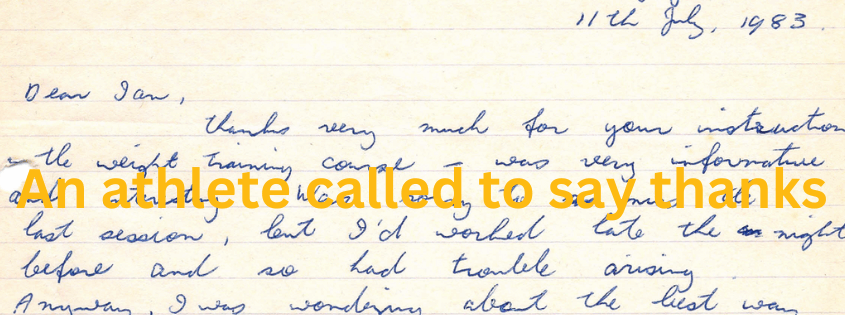
An athlete called to say thanks

Reflections on gratitude.

A few days ago, an athlete called me to say thank you. Unsolicited.  Not for the winning, which we did. But for the lessons shared.  You might ask ‘So what. There’s nothing special about a thank you.’ So, I will share this – the period of time the athlete was referring to occurred 30 years ago.

It is no coincidence that just a few weeks prior in a webinar with a global audience, I spoke about this:

And that’s just a little example of gratitude that it’s a lifelong gratitude from an athlete when you help them create a legacy and fulfil their potential.[1]

I say no coincidence because this expression of gratitude over this time frame is not an uncommon experience for me.

Those who spend a few days with me know it’s unlikely much time passes when a real athlete who I really helped win expresses their unsolicited gratitude. [2]

However, it still stands out.  For me, it speaks to the character of the athlete. I take as much pride in the person I have helped them become as in the sporting legacy.

I have encouraged this trait in writing:

Show gratitude. The human emotion of gratitude is one I value and teach in all aspects of living; however, in the context of the student, I strongly encourage you to use it. Whether the teaching is short or long, what you wanted to hear or not, express your gratitude. This rewards the teacher and encourages them to continue teaching – be it to you or subsequent students.[3]

The premium I place on culture is reflected by its presence in KSI’s 19 points of culture:

Gratitude … I am a truly grateful person. I say thank-you and show appreciation often and in many ways, so that all around me know how much I appreciate everything and everyone I have in my life. I celebrate my wins and the wins of my team and clients. I consistently catch myself and other people doing things right … [4]

Personal character traits, including gratitude, figure high in our athlete development message:

I don’t have an expectation for them, it’s their path in sport, but as far as behaviour and attitude, that’s not really negotiable. To do their best and be positive, show gratitude and be courteous, respectful. [5]

And it’s not just the athletes. As coach education is the almost-as-long-serving concurrent aspect or our combined service, we also receive similar in this genre – unsolicited, multi-decade later gratitude.

Ian,  your teaching has been something I have been using since we met over 20 years ago. One of the best decisions I made in my life.  It has helped me tremendously professionally  & personally. Just wanted to say thanks.—Miguel [6]

You might see others reach similar conclusions:

I think the same thing happens with relationships. Business, personal, family relationships, etc. They start off young and that’s when you can build almost a “relationship myelin” around them. You do that by being honest with people, by showing gratitude, by not overusing the connection, by treating it just right so it develops into something that can last a lifetime. If someone does something for you, show you are grateful.[7]

People often ask, ‘Who was your favorite athlete?’ To which I respectfully decline to answer, deflecting by saying something along the lines of ‘A parent should not have a favorite child’. Then I go on to say I can, however, tell you about those who make their mark by their character trait of consistent and long-term gratitude.

Such as the athlete whom I helped to a Silver Medal in the 1992 Auckland Commonwealth Games, who would send me an annual thank you card for years following…

Or the contact sport athlete who became the most capped in the world in his sport and reached out to me by phone annually for the year following…

Or the athlete who, 30 years later, gave me reason to share this.


References

[1] King, I., 2025, Optimal athletic performance, Kent, UK, Sat 11 Oct 2025 (Seminar/Video)

[2] King, I., 2019, How did you develop your approach to flexibility, Off the Record #50, 31 July 2019

[3] King, I., 2005, The way of the physical preparation coach, Ch 21 – Become a student

[4] King, I., 2009, KSI 18 Points of Culture

[5] King, I., 2014, Coaching Mastery, Cape Cod, 13-14 April 2014, USA (Seminar)

[6] King, I., 2025, Personal communication, Email received 25 March 2025

[7] Altucher, J., 2014, 10 Things I learnt when interviewing Tony Robbins about money, The Stanberry Digest,18 Nov 2014

What else don’t we know?

This article is not about sets and reps. However, I suggest it relates to our physical training. This story appears to be geographically specific. However, I suggest that if you dig deeper into the history of your own region, you may see relevance.  The message is we might believe we have a full grasp of the information, only to learn we don’t. And how that information could serve us to achieve our best and highest good.  The focus on conspiracies in our society appears to be rising. This is not a conspiracy story, but in less clear-cut circumstances, it may be relevant to other conspiracy theories.

Sqn Ldr John Francis Jackson                                                         

The main airport in Port Moresby is named Port Moresby International Airport (sometimes in full Port Moresby Jackson International Airport) and is the largest airport in the country.

As a commercial airport, it was built on the airport created by the Allied Forces in the New Guinea war campaign against the Japanese Imperial Army. It was named after  Royal Australian Air Force (RAAF) Squadron Leader John Francis Jackson, who was killed in action in 1942 while defending the city from Japanese forces.

John Jackson’s story is worth reading. The sacrifice, the risks, the determination, the willingness to defend his country. His two kids never got to know their father, as he went off to war shortly after they were born.[1] [2] [3] [4] [5] [6]

John Jackson’s courage, leadership, and ultimate sacrifice became a symbol of Australia’s and Papua New Guinea’s shared wartime struggle. [7]

Following Jackson’s death in combat on April 28 1942, the airport was named after him in various forms, including Jackson’s Drome, Jackson Field.  By the time I first flew into it in the early 1960s, it was known as Jackson’s Airport.

It was not until April 24 2017, that John’s story was formally recognized and his daughter Patricia Jackson and son Arthur Jackson were present to receive the acknowledgement, with the unveiling of a commemorative display. [8] That was 75 years later, almost to the day.

Bomana War Cemetery

John was buried at Bomana War Cemetery, [9] [10] [11]. The Bomana War Cemetery was officially opened on August 5 1944. I have strong memories of visiting this cemetery many times as a young boy. You can imagine the impact on a young person of seeing so many headstones. On the upside, the cemetery was always immaculately presented.

Kokoda 

One of the popular recreational activities for families living in the Port Moresby area was a day trip to Owen’s Corner in the Owen Stanley ranges, about a 40km drive out of Port Moresby, to walk and explore the trail that runs through the village of Kokoda. This trail was used by the Allies to provide a final defence against the Japanese Imperial Army, who were traversing the main island of PNG from the north, from their base in the town of Rabaul on the Island of New Britain.[12] [13]

The Kokoda Trail was a path that linked Ower’s Corner, approximately 40 km north-east of Port Moresby, and the small village of Wairopi, on the northern side of the Owen Stanley mountain range. From Wairopi, a crossing point on the Kumusi River, the Trail was connected to the settlements of Buna, Gona and Sanananda on the north coast. Its name was derived from the village of Kokoda that stood on the northern side of the main range and was the site of the only airfield between Port Moresby and the north coast. [14]

I recall it being called the ‘Trail’ – when I was walking it as a child, but I have since been corrected by many (who have never been there!) that it is ‘Track’!

“Kokoda Trail” and “Kokoda Track” have been used interchangeably since the Second World War and the former was adopted by the Battles Nomenclature Committee as the official British Commonwealth battle honour in October 1957. [15]

It was impactful to be in the foxholes and walk the same track as the Allied Forces did, albeit in a more playful mood. Or as playful as you can get, walking up and down the single steep path. The creeks in between the ridges provided relief.

Rabaul

The Japanese Imperial Army captured the township of Rabaul on the Island of New Britain on 23 January 1942. From there, they commenced an overland trek from the north of the main island of PNG to capture Port Moresby, which would have exposed Australia to greater attack. Australia was exposed, as it would have been difficult for Australia to defend its sparsely populated north. The Japanese surrounded Rabaul back to the Allied Forces on September 6 1945.

I was born in that town a decade and a half later.

War relics 

Whilst families enjoyed sites as the Kokoda Trail, kids in PNG enjoyed collecting war relics. The American Forces have been very ‘generous’ in what they had left behind. Our collection as kids was diverse and large.  You didn’t have to walk far from your home in towns such as Port Moresby to find war relics. It was something you could do on the spur of the moment on any afternoon after school.

Relatives who served in PNG

Many Australians have relatives or know someone who has served in the World Wars, and the Pacific campaign was no exception. I had an uncle who served in PNG. [16]

I thought I knew a lot about WWII in PNG

As you can see from the above, where I have sought to provide a snapshot of my belated exposure to the events of WW II in PNG, I had reason to believe I was all over it.

I had walked the paths, been in the foxholes, touched the relics, visited the war cemetery – and not just once. All the above was a regular occurrence.

And then in 2023, I learnt about an event on the 7th September 1943 at what I knew as Jackson’s Airport. It had been kept a secret for 80 years.

How secret?

General Douglas MacArthur ordered a shroud of secrecy around the crash and threatened to court-martial anyone who spoke of it. Relatives of the dead were kept in the dark.[17]

The day in PNG during WWII when a US plane killed 63 Australian soldiers

On September 7th 1943, at Jackson’s Field (Drome) a US Liberator bomber laden with fuel clipped a tree on take-off and crashed into a convoy of trucks carrying soldiers of the 2/33rd Australian Infantry Battalion. The result:

  • 60 Australian Army members from the 2/33rd Australian Infantry Battalion were killed
  • 2 Australian truck drivers killed
  • 11 US air service members killed
  • 90 other Australians were injured

I know the authorities had their reasons for the ‘secret’

I know the authorities of the Allied Forces had their reasons.

“For morale reasons, General Douglas MacArthur ordered a shroud of secrecy around the crash…”[18]

However, this decision was not without ramifications. I am not suggesting MacArthur didn’t consider them.

The connection for me continues

I learnt 80 years later that the Liberator involved, the “Pride of the Cornhuskers” was named in honor of Nebraska, home US state of the 21-year-old flight officer Howard J. Wood.   I took multiple trips to Nebraska in the late 1980s and early 1990s, spending time at the then headquarters of the NSCA in Lincol,n Nebraska.  I also have positive memories of my time spent with one of the original coaches of the NSCA, Boyd Epley,[19] and his crew, at the University of Nebraska[20].

To be clear:

“An Australian Army Court of Inquiry handed down its findings into the disaster in December 1943. It attached no blame to the pilot or crew of the Liberator, but ordered a review of airfield marshalling procedures to avoid putting future troop carrying trucks in danger at the end of runways.” [21]

The US military review was perhaps less forgiving:

A US Air Force Inquiry placed 90 per cent of the blame on pilot error during an instrument take-off and 10 per cent on the dark, foggy weather conditions. [22]

The enormity of the secret

This was the largest aviation disaster loss of lives – in peace or war – for Australia:

Former Sun-Herald editor Peter Allen, writing in the Order of Service for the ceremony, says: “Because Papua New Guinea was then under Australian administration, the crash still ranks as the biggest in Australian aviation history, in peace or war. Although being Australia’s worst aviation disaster, it remains one of the least known major accidents of World War II.”[23]

And yet no one knew about it…

Bigger than Black Hawk Down

Australia had its own version of the US Mogadishu Black Hawk down incident. [24] An aviation crash in 1996 involving two Black Hawk helicopters during a training exercise outside of Townsville by the Australian army, including the Special Air Services Regiment, resulted in the loss of 18 lives. [25]

This was a tragic incident. We were told at the time that this was Australia’s worst peacetime military aviation disaster.[26] I appreciate that’s technically correct, but in 1996, no one (other than the survivors in threat of court-martial) had any idea about the loss of lives in 1943.

What does this all mean 

Firstly, from a personal perspective.

I flew in and out of Jackson’s Airport more times than I can remember during a four-decade period spanning the 1960s to 2000. At no stage was I given the opportunity to pause and reflect on those who lost their lives on the 7th September 1943.  In my visits to the Bomana War Cemetery, I was not given a chance to visit their final resting place.

You could say that’s a ‘me’ problem, a ‘first-world problem’, and I would agree. It doesn’t change the fact that I feel denied a part of history for so long.

Now, from the perspective of the family and friends of the deceased. Many would have passed away by now and never known the truth.  And I can only imagine how those who received the belated information felt. Now that’s not a first-world problem. They deserved better.

Now, from your perspective. My goal in sharing this somewhat personal story – how I felt finding out so many years later about information intentionally withheld – was to bring to light the question for all of us –

What else don’t we know?

And that question relates both to life as well as to physical training information.

The only solace I can provide around this is that I am committed to sharing with you what I discover in relation to answers to the question I have asked since I set out on this journey – ‘What is the best way to train?”

And the final thought goes to those who gave their lives on the 7th of September 1943 at Jackson Fields, Port Moresby. I am sorry we could not recognize your sacrifice for those 80 years. When I fly into Jackson’s Field next, I will be thinking of you. When I’m back at Bomana next, I will visit with you.


References

[1] https://www.thenational.com.pg/jackson-airport-got-name/

[2] https://en.wikipedia.org/wiki/John_Francis_Jackson

[3] https://adb.anu.edu.au/biography/jackson-john-francis-10600

[4] https://www.awm.gov.au/collection/C2123818

[5] https://vwma.org.au/explore/people/633642

[6] https://www.facebook.com/groups/139215886513324/posts/2337901856644705/

[7] https://www.facebook.com/groups/139215886513324/posts/2337901856644705/

[8] https://pacificwrecks.com/aircraft/p-40/A29-8/2019/jackson-termianl-memorial.html

[9] https://www.cwgc.org/visit-us/find-cemeteries-memorials/cemetery-details/2014300/port-moresby-bomana-war-cemetery/

[10] https://en.wikipedia.org/wiki/Port_Moresby_(Bomana)_War_Cemetery

[11] https://www.awm.gov.au/collection/C65569

[12] https://en.wikipedia.org/wiki/Kokoda_Track_campaign

[13] https://www.awm.gov.au/collection/E84663

[14] https://www.awm.gov.au/collection/E84663

[15] https://www.awm.gov.au/collection/E84663

[16] KING, Charles Elvery : Service Number – N441284 : Date of birth – 20 Aug 1923 : Place of birth – ALSTONVILLE NSW : Place of enlistment – CASINO NSW : Next of Kin – KING B 

[17] https://www.smh.com.au/national/the-men-dying-still-haunt-me-the-day-a-us-army-crash-killed-62-australians-20230829-p5e0dw.html

[18] https://www.smh.com.au/national/the-men-dying-still-haunt-me-the-day-a-us-army-crash-killed-62-australians-20230829-p5e0dw.html

[19] https://huskers.com/staff/boyd-epley

[20] https://www.unl.edu/

[21] https://www.smh.com.au/national/the-men-dying-still-haunt-me-the-day-a-us-army-crash-killed-62-australians-20230829-p5e0dw.html

[22] https://www.smh.com.au/national/the-men-dying-still-haunt-me-the-day-a-us-army-crash-killed-62-australians-20230829-p5e0dw.html

[23] https://www.smh.com.au/national/the-men-dying-still-haunt-me-the-day-a-us-army-crash-killed-62-australians-20230829-p5e0dw.html

[24] https://en.wikipedia.org/wiki/Battle_of_Mogadishu_(1993)

[25] https://www.defence.gov.au/news-events/news/2021-06-12/25th-anniversary-black-hawk-accident

[26] https://www.abc.net.au/news/2016-06-11/survivor-remembers-1996-black-hawk-tragedy/7497914

Care and what’s missing

When a human is moving in a certain direction in life, it takes a specific amount of momentum to change direction. That may sound deep and cryptic, so let’s simplify it – until something significant (read catastrophic) happens, humans would prefer to conclude they are heading in the right direction.

Now, to relate that to sports and physical training, and competition.

How does an athlete know if their training is on track to achieve their goals? The scoreboard.

How does an individual training in what we call the general population space know if their training is on track? If it’s achieving their goals.

Before you conclude that the questions are asked and answered, allow me to dig deeper on this discussion.

In relation to the athlete, if you assume the primary driver is the scoreboard, then the feedback about the direction may be enough to redirect the training effort. However, that is a flawed assumption, for reasons I share below.

And when it comes to the general population, assumptions about their goals can also be misleading.

Case studies

Over the last five decades, I have been involved in numerous case studies of individuals, athletes, teams, sports coaches, and physical coaches. Here are a few of them.

The athlete said to me, “I have been on the World Cup circuit for 7 years now and never stood on the podium. If I don’t do that this year, I am going to quit racing.”

Hearing that clarity in metrics was music to my ears. We were on the podium in the first World Cup race of that next season.

Easy.

The athlete came to me as the two-time reigning gold medalist in their event. They knew their current trajectory was going to result in missing out on being selected for the next Olympics. They were taking action. We went to the next Olympics and got on the podium again.

That’s a relief because the stakes were so high.

The athlete came to me after making their decision to go to their third Olympics. They were so far off the pace that they would not even qualify. They had improved their Olympic result from Games one to Games two and wanted more. We went to the third Games and achieved the best results in not only their history, but their country’s history.

Tick.

The leadership group came to me and said, “We failed to make the playoffs last year and do not want to go there again. Can you help us?”

They were in the Grand finale the next year, and were back-to-back Champions two years later

Done.

The athlete came to me because an athlete I worked with suggested it. They were the reigning Gold Medalists and the first person from their country to hold that title in a country rich in that sport. They were struggling and even though the next Games were some years away, they may have been sensing the training direction was off track. I shared my thoughts, and they didn’t take them up.

The athlete never returned to the Olympics.

The athlete came to me because an athlete I had worked with suggested it. They had been selected to represent their country in their first Olympics the year before, but had been seriously injured in the lead up to the Games and were not able to go. I shared my thoughts, and they didn’t take them up.

A similar injury that prevented them from attending the prior Olympics has since occurred and we will have to wait and see what the future holds at the Olympic level.

The athlete came to me to qualify for their third Olympic Games after a long life happens layoff. Due to age and life odds were against them, and they recognized it. Not only did we qualify for the next Olympics, but the athlete set national records in the lead-up up to the Games, and the Games result was very encouraging.

After that Games, the athlete changed direction, failed to qualify for the next Games, and never returned to the Olympics.

The young would-be physical preparation coach asked me the question: “What’s missing? I can’t seem to attract athlete clients or teams?” I shared two key points – you have to pay your dues first, and in the meantime, gave them a strategy to put food on the table through general population clients.

They took action on the second part and rejected the first part, saying, “You think I’m being impatient. I believe I’m just driven.”

History shows they have general population clients; however, they have never achieved their once-written goal of working with elite athletes and teams. Or many athletes at all.

It was not the only time that I have seen instant gratification over-ride decision making in young want-to-be-significant-yesterday physical coaches, despite the obvious gap between their experience, competencies, and value in the marketplace, and who they believe they ‘deserve’ to be working with.

The two key variables – Care and what’s missing

I have come to conclude that there are two key variables in the path to sporting success. Caring enough to change direction and knowing what direction to pivot to.

Care is not as simple as it sounds. I could say an athlete who fails to successfully pivot and achieve at the level or fails to redirect to return to the highest level, doesn’t care. But that is potentially inaccurate. It’s more than ‘do they care’ – it’s what do they care about?

The initial assumption is often that they all care about the scoreboard and being the best that they can be at all stages of their career. I have learnt this is not so.

In the 1980s, I felt many of Australia’s Olympic athletes were just over the moon to get to the Olympics. Medaling was not high on their priority list, based on my observations. Alternatively, there was no individual or collective expectation that could or would occur.

And that observation is not restricted to the 1980s. I have and still this this in some athletes today.

Other factors that may be the self-selected dominant key performance indicators for elite athletes over and above the scoreboard may include:
• Pleasing their coach
• Gaining approval from stakeholders
• Getting noticed and getting attention’
• Looking good (e.g. what I call the ‘closet bodybuilder’)[1]

In my observations of the general population, factors that may be the self-selected dominant key performance indicators for the general population over and above their expressed goals may include:
• Just having the motivation to be consistent in training
• Feeling good about their training
• Feeling good about the short-term visual impact of their training

In summary, when I say whether an athlete cares, what I mean is whether the scoreboard is their dominant KPI. I am not judging them when it is not, however, I am going to call it ‘they don’t care’ (NB. About the scoreboard being the #1 KPI!)

Now let’s talk about what’s missing.

I don’t expect an athlete to know the answer to the question of what’s missing. Or more accurately, I appreciate their need for third-party guidance in seeking the answer to the question. I just hope the guidance they are given is optimal.

If I were to create general categories of athletes about the variables of care and what’s missing, this is what I would say:

Category

Care What’s missing?

1

Don’t care

Don’t know

2

Care

Don’t know

3

Care

Know

4 Don’t care

Know

Let’s dive deeper into my experiences with each category.

Category 1 – Don’t care, don’t know

These athletes don’t care about their performance limitations or declines at the highest level because, in my opinion, that is not their KPI. As they don’t see a problem, they do not buy into the thought that something is missing.

There is no shortage of individuals who will put their hand up to train these athletes, as they have more than enough credibility to post on their social media accounts.[2]

They don’t need my help to underperform. They do just fine all by themselves.

Category 2 – Care, don’t know

These athletes care about their performance limitations or declines at the highest level because the scoreboard is their KPI. They care less about what they look like; in fact, ideally, they don’t care at all, provided what they look like is shaped by the optimal nature of their training.

They may have some idea or no idea what is missing – that is far less important than their willingness to seek answers.

There is nothing more impressive than the nation or world’s best athlete having the humility and the courage to acknowledge training is off track and seek guidance. I just hope the guidance they get more than rewards them for their willingness to seek guidance.

These are my kind of athletes.

Category 3 – Care, know

These athletes care about their performance limitations or declines at the highest level because the scoreboard is their KPI. However, they have the answers to what’s missing, or believe they do. Are they on track?

If the proposed answer is:
• From the same pool of thinking that created the performance decrement[3], or
• From a third party with a poor track record; [4] or
• From a third party with limited to no track record, let alone a track record of success.[5]

Then I have less optimism for a successful outcome.

Category 4 – Don’t care, know

These athletes don’t care about their performance limitations or declines at the highest level because, in my opinion, that is not their KPI. They know there is a problem, and any idea of what’s missing, they have had the potential to reverse the rot. But they don’t care as their KPI is to be able to remain a professional athlete for as long as possible, to keep getting the rewards of such – media, social recognition, and income.

Most coaches and trainers would give a body part to be seen as associated. I prefer to be the pig (committed to winning), not the chicken (associated with someone who was once a winner).[6]

Window of opportunity

I am going to contrast the window of opportunity to pivot and change direction in training between the athlete and general population.[7]

I sense that the general population may be happier to pivot or change later or slower. They have a lot of time on their hands, considering the rough life span estimate of 80 years.

Athletes, on the other hand, at the elite end, do not have that luxury. If an athlete makes a decade at the top level, they have done well, and two decades is excellent. I see more and more athletes blowing their chance because they failed to pivot or failed to do it in a timely manner. But then again, I am using the word ‘fail’ relative to the KPI of the scoreboard. If we recognise other more dominant goals, they didn’t fail at all.

Yes, as rewards grow in sports, athletes are hanging in there longer. However, the window issue still remains.

Conclusion

As an athlete or end user in the general population, I trust you have found value in the simple message, based on five decades of experience and built on the simplicity of two key variables – do you care, and do you know the answer to what’s missing?

Yes, care needs to be matched to true drivers and not judged as a failure or a success.

Other synonym includes information and action. There was a time pre-internet when an individual may have been willing to take action but could not find the information. Such as how could anyone around the world back in the 1960s and 1970s get their hands on the magazine articles written by the great former Mr Universe bodybuilder and actor Reg Park or how could one get their hands on West German training literature before the Berlin Wall came down in 1989? Or their hands on training literature from the former Soviet Union before the same year?

However, the question is now less about whether you can get the information.

The challenge is now, which information? You have so much offered up, especially on the internet, by so many, that the risk is who or what you choose to guide you, not the absence of information. It’s great to have freedom of expression and vehicles for such expression; however, if the criteria for expert status are a keyboard, an internet connection and the desire to be significant even in the absence of competence, it creates a challenge for the consumer.

I commend you if you care that something may be missing in your training. I am even more hopeful for you if you are seeking answers and solutions because you realise you may not have all the answers to what may be missing or off-track in your training.

I just hope the guidance you are given is optimal.


Footnotes

[1] This is a term I coined some decades ago to describe any athlete who is more concerned with how they look than how they perform in their sport. These athletes never fulfil their potential.

[2] Case in point–an athlete failed to make a certain Games due to injury and yet post the Games was marketed by a coach on the basis of their qualification, without any reference to the failure to fulfil their potential due to injury. The athlete did not return to their chosen sport, pivoting sports instead, and was ruled out of that second-choice sport with more injuries just a year or so later.

[3] Case in point–I helped an athlete prepare for their first Games, and despite the success of those Games(the color of the medal was favorable) I expressed my concerns for the future. The athlete was successful in returning many times to the Games and podiumed more than once subsequently. However, in my opinion, they underperformed on what was possible. The answer to what was missing was, history shows, off-track. Was it because the solution had been potentially sourced from within the same thought pool that created the problem in the first place? Or was it that the solutions obtained from outside of the stakeholders were off track?

[4] Case in point–a professional team were the reigning champions when they sought to do one better and set records as well as win the championship. They hired a coach who, in my opinion, had a track record of helping top-of-the-table teams decline down the ladder. The team didn’t have my intimacy with performance tracking on that individual and moved forward. I called a collapse before the end of the season, and that came within the last few games. The coach was cut after one season, but the damage was done.

[5] Case in point–A multiple-time Olympian and reigning national record holder moved to a coach with no prior experience in that sport at that level. They got what you would expect–no further involvement at the Olympic level.

[6] Case in point–A service provider promotes a meetup with a once high-profile ‘client’ athlete who, unbeknownst to the uniformed, had over the years slid to a ranking worse than 1,000. And a few weeks later, the athlete entered a top-level competition only to withdraw early due to injury. The athlete was squeezing the last out of a successful and profitable career, and at least they have earned that…

[7] My experience with the latter is limited, so anyone who wants to throw a rock at that, I will have to accept that. However, when it comes to my personal conclusions and observations about elite athletes, it is not so easy to dismiss.


© Ian King 2025. All rights reserved.

What’s in a name? Pt 2 – Considering the bigger picture of physical preparation

As I share earlier during the 1980 I faced the challenge of adopting a job title, in a role that did not exist in Australia. Australia at that time had begun to model the national coaching system of Canada, which in that decade was one of the most highly funded coaching programs in the Western world due to the government funding leading up to their two decades of Olympic Games – the Montreal Summer Olympics in 1976 and the Calgary Winter Olympics in 1988.

However, neither the Coaching Association of Canada or the Australian Coaching Council provided any clarity, recognition or specific education for the role of physical training of athletes.  The Canadians provided excellent education, including by their imported experts such as Hungarian Tudor Bompa, however to my knowledge there was no-one professionally physically training athletes in Canada or Australia in in 1980, so it was understandable that this gap in education and recognition existed.

I looked to dominant influences overseas and narrowed it down to two – the United States National Strength & Conditioning Association (NSCA) and an Eastern European perspective on athlete training by Tudor Bompa as outlined in his1983 book ‘The Theory and Methodology of Training’.

Ultimately, I chose the Eastern European approach as it resonated more with me than the American approach. However, it was not a simple add the word coach to the term ‘physical preparation’. I studied and reflected for years to develop my own approach to physical preparation.

I have consistently referenced the influence of Tudor Bompa.  This professional and ethical referencing appears to have lost favour in the post 2000 internet and social media world, where at best you can hope for is a single ‘credit’ given, and then it is open season on ones’ original publishing’s.

…raised by Tudor Bompa in his classic book Theory and Methodology of Training: The Key to Athletic Success  (first published 1983).  This is an excellent text and I believe it should be in every coach’s library.…[1] 

I have been influenced in how I define the physical qualities by the land-mark work of Tudor Bompa. His 1983 text Theory and Methodology of Training is a must-have in the professional library of every physical preparation coach. [2] [3]

My greatest influence in the area of structuring the physical qualities has been Tudor Bompa, and I encourage you all to purchase and study at least his 1983 (more recent editions) book, Theory and Methodology of Training.  You will note that unlike certain US ‘authors’ of the post 2000 period, I consistently and respectively (not to mention ethically) reference and credit my sources of influence.….Ki

Not only was Tudor’s book one of the most influential books I have read, but I have also met Tudor on several occasions and shared the speaking platform with him. My goal is to be professional, ethical, and respectful of those who came before. I also aim to be gain a mutual respect manifested in a warm greeting when we next meet in person, in this life or the next. [4]

The aim of this article is to share the influences and the rationale that lead to my conclusions about physical preparation in context – considering the bigger picture of athlete preparation.

The bigger picture of athlete preparation

Before drilling deeper into the term physical preparation, I took a step back and sought to understand the bigger picture or content and structure of physical preparation with athlete preparation. Keeping in mind that my career has been exclusively about training the athlete, and typically elite athletes.

There are a number of significant differences between what Tudor promoted in his book and what I have settled upon.

My greatest influence in the area of structuring the physical qualities has been Tudor Bompa…  However I didn’t leave my research at this. I have gone on and developed additional concepts, original definitions and new sub-qualities….Ki

Firstly, I noted that Tudor used the term ‘training factors’ to describe the components of ‘athletic performance’.  It is a minor point, however I have instead used the term ‘components’.

Secondly, I noted that Tudor preferred ‘athletic performance’, including in the sub-title of his 1983 book. I elected ‘athletic preparation’.  I have more focus on the process of preparation and belief performance is the product.

I believe the term ‘physical preparation’ is a better term.  Athletic preparation another.  [5]

These are arguable minor and subtle differences; however I believe it’s important to acknowledge the differences.

The third point of difference between what I have refined over the forty years since first being exposed to Tudor’s book is more significant – it is the ‘factors’ (Bompa’s word) or the ‘components’ (my preferred word) that contribute to athletic ‘performance’ (Bompa) or ‘preparation’ (King).

Here is the comparative list as published by Bompa and myself.

Table of respective ‘factors’ or ‘components’ used by Bompa and King

Bompa

King

Physical preparation Physical preparation
Technical preparation Technical preparation
Tactical preparation Tactical preparation
Theoretical preparation Psychological preparation

You will note that I used only three of Bompa’s four ‘factors’ and substituted ‘Theoretical’ for ‘Psychological’ in my four ‘components’.  I also note that Bompa dedicated much less text (approximately 25%) to his ‘Theoretical preparation’ compared to the text dedicated to each of his other three ‘factors’. Literally interpreted one could conclude that he placed lesser importance on this factor. This is not how I approach ‘Psychoological preparation’ in that I do not treat it as a lessor factor.

Which leads to the fourth point of difference, and I suggest this points of difference have progressed upwards in significance as we work through them, meaning this point is of great significance.

I now direct attention to relative importance. Now I acknowledge that this is in part inferences, rather than stated.  I say in part because Bompa did express his values in text:

“Physical preparation has to be considered as one of the most and in some cases the most important ingredient in training required to achieve high performance.” [6]

I take a literal interpretation that Bompa presented his four ‘factors’ in order of relative importance.  Bompa’s list or sequence is not alphabetical.

Generally speaking, I believe that one should either present content alphabetically, to remove inference of relative value, or in a sequence that represents one’s values.

In the original 1999 version of our online course titled ‘Foundations of Physical Preparation’ [7] and in the original edition of the 2000 book of the same name [8] I presented the components alphabetically.

2.4    Athletic Preparation

Physical Preparation

Psychological Preparation

Tactical Preparation

Technical Preparation[9]


However, when I present components of athletic preparation reflecting a value set, I present a sequence that is different to Bompa’s and reflect the values around these ‘factors’ or ‘components that I have developed during the last five decades.  We go into more depth about this in our the KSI Coach education program.[10]

There is one more sequence of the components of athletic preparation that I believe needs to be referenced here, and that is the individualized sequence of importance for any given athlete. The following is from my 2005 book ‘The Way of the Physical Preparation Coach’:

Following a review of all components that contribute to or influence success in athletic preparation, generally speaking we prioritize the training process to address the weakness ahead of the strength.

Once we know the needs of the sport, we review the abilities of the athlete/client in each of these athletic components (psychological, technical, tactical, and physical). Our physical preparation training program design will reflect the strengths and weakness we discover, by placing priority in training in the short term on the weakest component, provided we conclude that this is optimal in the long term planning of the athlete/client.[11]

Conclusion

In closing on this subject, I believe its warranted to add some additional caveats to this discussion.

The first caveat or footnote relates to the dangers of assuming or treating the athlete/client from a compartmentalized perspective. For example, a physical preparation coach seeking to optimize the performance outcomes through a narrow or predominant focus on physical preparation:

In general application, physical preparation is just one of many interconnected components of a human, and therefore all components should be recognized and addressed.

At the highest and most simplistic level, these include but are not limited to the mind, body and the spirit.  Training a person from this holistic approach is more optimal and effective then training the body in isolation. [12]

The second footnote rises from this reality, that there is a physical overlap or residual implications affecting recovery in athletes who train technically and tactically for their sport:

Athletic preparation has been described as including a number of factors, one of which is physical preparation.  Whilst training the physical qualities, it is important to remember that it is virtually impossible to separate the physical training from the other training qualities. Therefore the integration of the effect of the total training should always be considered when planning, conducting and evaluating the physical training. [13] [14]

The third footnote is that no-matter how much lip service[15] a physical coach may give to their ability to integrate all training, mastery of four components of athletic preparation is not achieved in a short period of time. It will take a lifelong approach to being a student combined with high volume of practical application with a large sample size of athletes in a multi-year approach to achieve mastery.

The physical preparation coach’s ability to effectively and optimally address physical preparation within the context of the total components of athletic preparation will be influenced by the coach’s mastery of each of these components. 

Greater results will be achieved in physical training if the physical preparation coach has a mastery of aspects as they relate to the mind, body and spirit of the athlete. [16]

The aim of this article was to provide historical and contextual background to my conclusion I reached about physical preparation within the context of the bigger picture of athlete preparation.   I acknowledge that for those working with general population, or those whose services are narrowed to less than the full components of athlete preparation, this information may have less meaning.

However, for those who seek to be the best they can be in service of the athlete, you may find more relevance in this discussion. What I cannot give you is the delayed gratification and the desire to remain a student (as opposed to seeking to be the teacher).


References

[1] King, I., 1997, Winning and Losing (Book)

[2] King, I., 2011, Legacy – Ian King’s Training Innovations (Course)

[3] King, I., 2013, Legacy – Ian King’s Training Innovations (Book)

Ki King, I., KSI Coaching Course, L1 Legacy (Course)

[4] I am not sure if the new age ‘author’ hiding behind the keyboard feels empowered to breach intellectual property because they don’t anticipate meeting the original author in person. Or is it a simple manner of a degradation of ethics and morality in this stage of history? Or perhaps it is the entitlement attitude of the younger generation – they believe they simply deserve to have the right to copy. And perhaps the desire to be perceived as signification, though more followers on social media is a factor Or perhaps it is a mix of all of the above.

Ki King, I., KSI Coaching Course, L1 Legacy (Course)

[5] King, I., 1997, Winning and Losing (book)

[6] Bompa, T., 1983, Theory and Methodology of Training (Book)

[7] King, I., 1999, Foundations of Physical Preparation (Course)

[8] King, I., 2000, Foundations of Physical Preparation (Book)

[9] King, I., 1999, Foundations of Physical Preparation (Course) – Lesson 2: Training Theory

[10] KSI Coach Education circa 1999 https://kingsports.net/courses/

[11] King, I., 2005, The Way of the Physical Preparation Coach, p. 29

[12] King, I., 2005, The Way of the Physical Preparation Coach, p. 29

[13] King, I., 1999, Foundations of physical preparation (Course)

[14] King, I., 2000, Foundations of physical preparation (book), p. 25

[15] Or social media posts

[16] King, I., 2005, The Way of the Physical Preparation Coach, p. 30-31

What’s in a name? Pt 1 – The origin and intent of the term physical preparation coach

In the 1980s, I  forged a career in Australia that did not exist. The role did not exist, and there was no job title. What would I call myself?  I looked around the world for guidance and found two dominant influences – the United States National Strength & Conditioning Association (NSCA) and an Eastern European perspective on athlete training by Tudor Bompa, whose 1983 book ‘The Theory and Methodology of Training’ was one of the most influential books I was exposed to in that decade.

The answers and conclusions I reached from my search for a professional job title continue to shape the world in various ways.   With a growing number using the term ‘physical preparation coach’, it’s timely to share the origin and intent of this term. In this article, I achieve this through consideration of cultural influences, sports history, and my personal experiences.

Australia

I entered the profession in 1980 in Australia through an exercise physiology degree and that was the only possible specific outcome expected for graduates. And that was only available in corporate fitness. I knew only a few graduates that got that work. The rest added a second degree (e.g., teaching, physiotherapy etc.) or got work in totally unrelated fields.

There were no jobs in sport outside sports administration for graduates. At best you could hope to get a volunteer role as a fitness coach or sprint coach. For that you might receive a season pass. However, to get those roles you needed no qualification other than a proven personal history in the activity.

Therefore, a very fit person who loved to run a lot could be considered as a candidate for a role as a fitness coach, as all fitness training for sport in the early 1980s in Australia was distance running with a sprinkling of interval training

And a former sprinter could be considered as a candidate for the role of sprints coach. All sprint training for sport conducted in Australia in the first half of the 1980s was interval training, as the bias in speed was towards endurance.  And keep in mind that many sports, including what was then the Victorian Football League (VFL – now the Australian Football League or AFL) didn’t endorse any short sprinting as it was considered too risky for their players to engage in due to the risk of soft tissue injuries.

You might be wondering what was going on with strength training in sport in that era. The very few sports that engaged in strength training limited their work to bodyweight exercises, and for this training was supervised by the sport coach e.g. some swim coaches such as the late John Carew (this story shared with me in person) would have basic equipment on the side of the pool such as a chin up bar. However, this was rare. Strength training was taboo in Australian sports, as it apparently caused athlete to be ‘muscle bound’ and or injured.

In fact the status of the sporting training industry in the early eighties was one where strength training was rarely conducted.  The ‘it will slow me down’, and ‘it will make me inflexible’ attitudes dominated.  Training in general was at that time a neglected area.  The Australian Rules Football players (then playing in the VFL) were participating in various types of formal training, but the strength training was circuit training with light weights and the conditioning consisted of carrying bricks in the hands for many kilometers.  At least they were doing something.  Rugby league players in the New South Wales Rugby League were starting to do things, but they were even more archaic than the Australian Rules footballers.  Rugby union players were warming up by stubbing out their cigarettes and then commencing a short game of touch football.  Swimmers would fade like superman faced by kryptonite at the mere mention of the word weight training. [1]

And in all fairness, the way strength training was being conducted, the concerns were reasonable. I specifically refer to the influence of bodybuilding training, the methods, of which I have spoken about in length in prior publications.

A lack of awareness of the ‘need for speed’ (attempted acceleration) in the concentric phase in the power athlete may result in an adaptation to a non-specific rate of force development.  This is the same non-effective and perhaps detrimental training effect that occurred when athletes first started using strength training and used the bodybuilding methods. [2]

As the only one in my entire university department with a serious interest in strength training.

My main focus in study at that time was on strength.  I appeared to be the only one in my course with this interest at that point in time.  Aerobic training was the main focus of research in the seventies and early eighties.  The main vocational specialty areas being pushed onto students at that time (outside of physical education teaching) was laboratory testing.  A number of graduates went out and established commercial laboratory fitness testing facilities and services – with limited success.  Corporate fitness was also being promoted as a future growth area. [3]

I was confident that there was a better way for athletes to strength train than the dominant paradigms and was committed to helping athletes achieve that.

However, who was getting to train athletes in the early 1980s? It wasn’t happening. At best you could get a job in the fitness industry as a ‘gym instructor’, and if athletes just happened to be gym members, you may get contact with them.

I was in a unique situation at my university during the early 1980s for a number of reasons. Firstly, the weightlifting club I was involved in attracted athletes who embraced strength training in that era, including track and field athletes, martial artists, and contact sport athletes. Secondly as the only university in our state at that time, we had an incredible number of Olympians as students, and I became the first strength consultant employed at the university gym. Essentially, I spent more time in the gym that I did in the lecture rooms and that didn’t go unnoticed by the athletes. That became my classroom.  Additionally I was working part-time and one off gigs as an exercise physiologist and gym instructor at various gymnasiums.

In summary Australia did not have a term to describe a profession of training athletes because the role did not exist.  The Australian Sports Medicine Foundation (ASMF) was founded in 1963 and they provided education in the area of in the moment treatment of injuries as their only specific to sport educational offering. Individuals who filled these roles were referred to as ‘trainers’, typically of lower qualifications than a physiotherapist, whose role was to provide massages, run water, and provide immediate assistance to athletes at the moment of injury.

And that was the landscape of Australian sport when I was creating a role that didn’t exist – providing professional commercial physical training services to athletes. When asked what I did in the early 1980’s I would say ‘I train athletes’. To which the response was invariably ‘What sport?’ People assumed I was a sports coach because there was no other role in sport at that time.  I was doing something that had no name in Australia.

United States of America

There had been a different role and position description in the US.  This was referred to as a ‘strength coach’.  The use of this term and role professionally can be traced back to the 1950s in the United States.

Gym owner and former team manager of the 1952 US Olympic Weightlifting Team, Alvin Roy, is proposed to have been the first strength training consultant engaged in US high school, notably in the sport of American football. [4]  Roy went on to also become possibly the first strength training consultant engaged in American college sport when he worked with the Louisiana State University Football team in 1958.  [5]

Alvin Roy is also considered to be the strength consultant in professional sport in the US when in 1963 he was hired to work with the 1963 San Diego. And Kim Wood is considered the first full time NFL strength coach when he was hired to work for Cincinnati Bengals. [6]

Boyd Epley is considered the first strength coach hired full-time in US college sport  when he was hired in 1969 by the Athletic Director of the University of American to work with the American football team.[7]

The National Strength Coaches Association (NSCA) was formed in the US in 1978, specifically to unite and support strength coaches at the college level in American football. In 1981, they changed the name to the National Strength & Conditioning Coaches Association, broadening the title to include ‘conditioning’, without having to change the acronym of NSCA.

Europe

There was less clarity from Europe as to a term or job description. The UK was relatively underdeveloped in the area of sports training. One of the key influences in the UK was Frank Dick, who published a book titled ‘Training Theory’ in 1974.  There was no reference to a term for the coach responsible for physical training, likely because this was most likely the responsibility of the head coach in the UK during that era.  Most found the information from the Soviet Union during the 1980s to be unreliable, in part due to the Cold War between the US and the USSR (1947-1991).[8]  The ‘Berlin Wall’ didn’t fall until 1989, therefore, literature coming out of the well-organized state known as East Germany was limited.

This didn’t mean literature was devoid in Europe. It just wasn’t readily available to the rest of the world.  This changed when Canada became one of the most highly funded nations in sport preparation in the lead up to their two decades of Olympic Games – the Montreal Summer Olympics in 1976 and the Calgary Winter Olympics in 1988.

One such immigrant to Canada was Hungarian Tudor Bompa, who released the first edition of this book, ‘Theory and Methodology of Training’, in 1983.

In this book, he shared a very different approach to sports training compared to the only other organized theory, that of the US – and their ‘strength and conditioning’ –  identifying what he referred to as four ‘Training Factors’ – physical, technical, tactical and theoretical.

Choosing a path

As a student of the profession seeking direction in a career path that did not exist in Australia (at least not in a commercial, get paid for your services, sense), I was left to make a decision – which path to follow? What name do I use to describe my services? Do I follow the path that made the most sense – the Eastern European influence shared in the book by Bompa? Or do I follow the US path, one that was showing greater growth in public awareness, and backed by the might of the US culture, population, popularity and money?

I share this dilemma in my 1997 book ‘Winning and Losing’:

The concept of strength and conditioning as a role has a strong American influence.  Not so the concept of someone responsible for physical preparation. [9]

I did not rush to this decision. The pattern I have established is test and refine a training concept or innovation for about a decade before sharing it as a recommended way.

In 1988, the NSCA arrived in Australia. I took on the state director role in that first year, and then the National Executive Director role (an unpaid role) for nearly a decade.

During that time, a few key events occurred. I share two of them with you.

A conversation that shaped the acceptance of the term ‘Strength & Conditioning’ in Australia

After the arrival of the NSCA in Australia, and in my role as the leader, I had a meeting with the key figure in the Australian Sports Commission/Coaching Council. The NSCA of Australia (as it was known at that time) was seeking recognition from this body to be treated in the same way as all other sports registered with and recognized by the government regulatory body.

He expressed serious reservations about this, specifically that he felt that the NSCA was too unbalanced, more about strength training than other forms of physical training. I assured him that was not the case. I believe that this conversation was pivotal in achieving the goal of the NSCA of Australia. I also believe my answer was naïve.

I have reflected on that conversation a lot since and realize in retrospect how my advocacy shaped the history of this movement in Australia.

By the early 1990s, as I developed a more thorough insight into the NSCA in the US,  I had moved away from my support for the term ‘strength & conditioning’.

Inspired by Bompa’s writing, I formed the belief that adding the word ‘coach’ after the training factor ‘physical preparation’ would be a far better alternative.

I shared the reasons for this conclusion in my 1997 book ‘Winning and Losing’:

I am not supportive of  the  term strength and conditioning for two reasons.  …  Firstly, I am not supportive of this term because of the implications of its literal interpretation.  It separates strength from all the other elements of conditioning.  I believe this is inappropriate and misleading.  It then, by virtue of word sequence, places strength as a more important component than conditioning.  Again I suggest that this is inappropriate and misleading.  The message being given by the mere use of this term is counterproductive – unless you agree with strength being separate and more important.

The second reason I am not supportive of the term strength and conditioning is based on a historical understanding of it’s origin.  In 1978 the National Strength Coaches Association (NSCA) was created in mid-west America.  In 1982, for whatever reason, the word ‘Coaches’ was replaced with the word ‘Conditioning’.  (it fitted in with the initials NSCA!)  This association has gone on to shape and influence the role of ‘strength and conditioning coaches’ throughout the western world.

…. I believe the term ‘physical preparation’ is a better term.  Athletic preparation another.  [10]

A second conversation that shaped the future of the term ‘strength & conditioning’ in Australia.

Following on from my formative late 1980s conversation with a key government figure and the resultant regret, I did not want to be in that position again. I had decided that the term ‘physical preparation coach’ would be my path.

In the early 1990s, an opportunity arose to change the NSCA of Australia to an independent organization. This was not a breakaway in any sense. The population of the target audience in Australia was so small the organization struggled to stay afloat, and the US NSCA was clear in their lack of interest at that time in establishing themselves outside of the US.

A meeting of the then Board of Directors was called to discuss and decide on the future of our organization.  I saw this as an opportunity to move the organization to a term more aligned with my values. At the same time, I recognized that the organization was not mine per se, and that the Board would ultimately make that decision.

I shared this story and the outcome in my 1997 book ‘Winning and Losing’:

  In 1993, I proposed to the then Executive Committee that the NSCA (Australia) be replaced by a Australian organization, with no royalties being paid to America, providing publishing opportunities to Australians, and providing information relevant to Australian sport, employment and culture.  This recommendation was accepted.  However my views that the term strength and conditioning be deleted was not supported.  The end result – The Australian Strength and Conditioning Association.  This decision may have had a big impact on the acceptability of this term in Australia today. [11]

I accepted the decision of the board and continued to serve the organization for the rest of the decade, despite holding different values about the title I preferred to describe my services.  Up until 1996, I was one of the only individual gaining full-time income in Australia training athletes, and the broader sporting bodies had not been exposed to the term ‘strength & conditioning’, so what I referred to myself as was not an issue.

Post 1996, certain changes occurred in the Australian sporting landscape, and the awareness of this term ‘strength & conditioning’ grew at a faster rate. This and other factors led me to decide in 1999 to commence my own coach education program.

Adoption of the term ‘physical preparation coach’

Up until I published my 1997 book ‘Winning and Losing’, only a few Australians in the physical training niche had heard of my term, and some later adopted it.  After the release of my 1997 book and subsequent books, along with the commencement of the KSI Coach education program in 1999, others around the world who were exposed first-hand to this term began to adopt it.

It’s now been 40 years since I was first faced with the dilemma of what path to choose in the title of my services and its associated training values.  I see the term now being used in a ‘second generation’ sense, that is by individuals who did not learn it firsthand from me.

For anyone who values origins and intents, this journey back in time may serve to educate.

Conclusion

In this article, I have sought to share with you the origin and intent of the term ‘physical preparation coach’. I have consistently referred to and recommended the book by Tudor Bompa, as this book shaped my thinking.

…by Tudor Bompa in his classic book Theory and Methodology of Training: The Key to Athletic Success  (first published 1983).  This is an excellent text and I believe it should be in every coach’s library.  Not an easy book to read first up, but one which you will find yourself returning to as a reference guide.  An excellent starting point to give you structure in theory and methodology. [12]

I have no ‘skin in the game’ as to what term you use to describe yourself. At the end of the day, it is a semantic. I am less interested in a persons name or title, and more interested in how they conduct themselves and serve the athlete/client.

I have seen the term ‘physical preparation coach’ abused by individuals who I suggest apply to term to themselves to provide the perception they offer more than they do.  As the person who coined the term, it was intended to be used as a reflection of a more balanced and holistic approach than what the term ‘strength & conditioning’ implies. Most personal trainers, from my perspective, typically work with only two physical qualities, e.g., strength and endurance. Unless your services offer a full suite of physical preparation training, then the use of physical preparation is not relevant.

Finally, both the term ‘strength & conditioning coach’ and ‘physical preparation coach’ have one word in common – coach. For me, coaching involves regular collaboration over the training process. Most physical coaches operate from a prescriptive approach, and as such, the term ‘coach’ is not relevant on this basis.


References

[1] King, I., 1997, Winning and Losing (book)

[2] King, I., 1998, How to Write Strength Training Programs (book)

[3] King, I., 1997, Winning and Losing (book)

[4] King, I., 1997, Winning and Losing (book)

[5]  https://titansupport.com/category/ken-leistner/

[6]  https://titansupport.com/category/ken-leistner/

[7] Shurley, JP, and Todd, JS. “The Strength of Nebraska”: Boyd Epley, Husker Power, and the Formation of the Strength Coaching Profession. J Strength Cond Res 26(12): 3177–3188, 2012

[8] https://en.wikipedia.org/wiki/Cold_War

[9] King, I., 1997, Winning and Losing (book)

[10] King, I., 1997, Winning and Losing (book)

[11] King, I., 1997, Winning and Losing (book)

[12] King, I., 1997, Winning and Losing (book)