
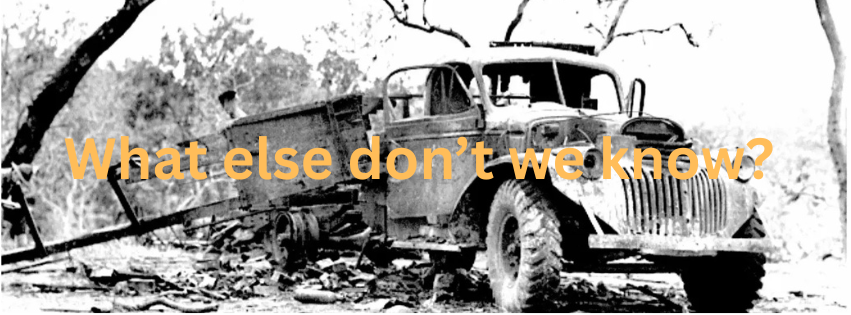
What else don’t we know?
This article is not about sets and reps. However, I suggest it relates to our physical training. This story appears to be geographically specific. However, I suggest that if you dig deeper into the history of your own region, you may see relevance. The message is we might believe we have a full grasp of the information, only to learn we don’t. And how that information could serve us to achieve our best and highest good. The focus on conspiracies in our society appears to be rising. This is not a conspiracy story, but in less clear-cut circumstances, it may be relevant to other conspiracy theories.
Sqn Ldr John Francis Jackson 
The main airport in Port Moresby is named Port Moresby International Airport (sometimes in full Port Moresby Jackson International Airport) and is the largest airport in the country.
As a commercial airport, it was built on the airport created by the Allied Forces in the New Guinea war campaign against the Japanese Imperial Army. It was named after Royal Australian Air Force (RAAF) Squadron Leader John Francis Jackson, who was killed in action in 1942 while defending the city from Japanese forces.
John Jackson’s story is worth reading. The sacrifice, the risks, the determination, the willingness to defend his country. His two kids never got to know their father, as he went off to war shortly after they were born.[1] [2] [3] [4] [5] [6]
John Jackson’s courage, leadership, and ultimate sacrifice became a symbol of Australia’s and Papua New Guinea’s shared wartime struggle. [7]
Following Jackson’s death in combat on April 28 1942, the airport was named after him in various forms, including Jackson’s Drome, Jackson Field. By the time I first flew into it in the early 1960s, it was known as Jackson’s Airport.
It was not until April 24 2017, that John’s story was formally recognized and his daughter Patricia Jackson and son Arthur Jackson were present to receive the acknowledgement, with the unveiling of a commemorative display. [8] That was 75 years later, almost to the day.
Bomana War Cemetery
John was buried at Bomana War Cemetery, [9] [10] [11]. The Bomana War Cemetery was officially opened on August 5 1944. I have strong memories of visiting this cemetery many times as a young boy. You can imagine the impact on a young person of seeing so many headstones. On the upside, the cemetery was always immaculately presented.
Kokoda
One of the popular recreational activities for families living in the Port Moresby area was a day trip to Owen’s Corner in the Owen Stanley ranges, about a 40km drive out of Port Moresby, to walk and explore the trail that runs through the village of Kokoda. This trail was used by the Allies to provide a final defence against the Japanese Imperial Army, who were traversing the main island of PNG from the north, from their base in the town of Rabaul on the Island of New Britain.[12] [13]
The Kokoda Trail was a path that linked Ower’s Corner, approximately 40 km north-east of Port Moresby, and the small village of Wairopi, on the northern side of the Owen Stanley mountain range. From Wairopi, a crossing point on the Kumusi River, the Trail was connected to the settlements of Buna, Gona and Sanananda on the north coast. Its name was derived from the village of Kokoda that stood on the northern side of the main range and was the site of the only airfield between Port Moresby and the north coast. [14]
 I recall it being called the ‘Trail’ – when I was walking it as a child, but I have since been corrected by many (who have never been there!) that it is ‘Track’!
“Kokoda Trail” and “Kokoda Track” have been used interchangeably since the Second World War and the former was adopted by the Battles Nomenclature Committee as the official British Commonwealth battle honour in October 1957. [15]
It was impactful to be in the foxholes and walk the same track as the Allied Forces did, albeit in a more playful mood. Or as playful as you can get, walking up and down the single steep path. The creeks in between the ridges provided relief.
Rabaul
The Japanese Imperial Army captured the township of Rabaul on the Island of New Britain on 23 January 1942. From there, they commenced an overland trek from the north of the main island of PNG to capture Port Moresby, which would have exposed Australia to greater attack. Australia was exposed, as it would have been difficult for Australia to defend its sparsely populated north. The Japanese surrounded Rabaul back to the Allied Forces on September 6 1945.
I was born in that town a decade and a half later.
War relics
Whilst families enjoyed sites as the Kokoda Trail, kids in PNG enjoyed collecting war relics. The American Forces have been very ‘generous’ in what they had left behind. Our collection as kids was diverse and large. You didn’t have to walk far from your home in towns such as Port Moresby to find war relics. It was something you could do on the spur of the moment on any afternoon after school.
Relatives who served in PNG
Many Australians have relatives or know someone who has served in the World Wars, and the Pacific campaign was no exception. I had an uncle who served in PNG. [16]
I thought I knew a lot about WWII in PNG
As you can see from the above, where I have sought to provide a snapshot of my belated exposure to the events of WW II in PNG, I had reason to believe I was all over it.
I had walked the paths, been in the foxholes, touched the relics, visited the war cemetery – and not just once. All the above was a regular occurrence.
And then in 2023, I learnt about an event on the 7th September 1943 at what I knew as Jackson’s Airport. It had been kept a secret for 80 years.
How secret?
General Douglas MacArthur ordered a shroud of secrecy around the crash and threatened to court-martial anyone who spoke of it. Relatives of the dead were kept in the dark.[17]
The day in PNG during WWII when a US plane killed 63 Australian soldiers
 On September 7th 1943, at Jackson’s Field (Drome) a US Liberator bomber laden with fuel clipped a tree on take-off and crashed into a convoy of trucks carrying soldiers of the 2/33rd Australian Infantry Battalion. The result:
- 60 Australian Army members from the 2/33rd Australian Infantry Battalion were killed
- 2 Australian truck drivers killed
- 11 US air service members killed
- 90 other Australians were injured
I know the authorities had their reasons for the ‘secret’
I know the authorities of the Allied Forces had their reasons.
“For morale reasons, General Douglas MacArthur ordered a shroud of secrecy around the crash…”[18]
However, this decision was not without ramifications. I am not suggesting MacArthur didn’t consider them.
The connection for me continues
I learnt 80 years later that the Liberator involved, the “Pride of the Cornhuskers” was named in honor of Nebraska, home US state of the 21-year-old flight officer Howard J. Wood. I took multiple trips to Nebraska in the late 1980s and early 1990s, spending time at the then headquarters of the NSCA in Lincol,n Nebraska. I also have positive memories of my time spent with one of the original coaches of the NSCA, Boyd Epley,[19] and his crew, at the University of Nebraska[20].
To be clear:
“An Australian Army Court of Inquiry handed down its findings into the disaster in December 1943. It attached no blame to the pilot or crew of the Liberator, but ordered a review of airfield marshalling procedures to avoid putting future troop carrying trucks in danger at the end of runways.” [21]
The US military review was perhaps less forgiving:
A US Air Force Inquiry placed 90 per cent of the blame on pilot error during an instrument take-off and 10 per cent on the dark, foggy weather conditions.” [22]
The enormity of the secret
This was the largest aviation disaster loss of lives – in peace or war – for Australia:
Former Sun-Herald editor Peter Allen, writing in the Order of Service for the ceremony, says: “Because Papua New Guinea was then under Australian administration, the crash still ranks as the biggest in Australian aviation history, in peace or war. Although being Australia’s worst aviation disaster, it remains one of the least known major accidents of World War II.”[23]
And yet no one knew about it…
Bigger than Black Hawk Down
Australia had its own version of the US Mogadishu Black Hawk down incident. [24] An aviation crash in 1996 involving two Black Hawk helicopters during a training exercise outside of Townsville by the Australian army, including the Special Air Services Regiment, resulted in the loss of 18 lives. [25]
This was a tragic incident. We were told at the time that this was Australia’s worst peacetime military aviation disaster.[26] I appreciate that’s technically correct, but in 1996, no one (other than the survivors in threat of court-martial) had any idea about the loss of lives in 1943.
What does this all mean
Firstly, from a personal perspective.
I flew in and out of Jackson’s Airport more times than I can remember during a four-decade period spanning the 1960s to 2000. At no stage was I given the opportunity to pause and reflect on those who lost their lives on the 7th September 1943. In my visits to the Bomana War Cemetery, I was not given a chance to visit their final resting place.
You could say that’s a ‘me’ problem, a ‘first-world problem’, and I would agree. It doesn’t change the fact that I feel denied a part of history for so long.
Now, from the perspective of the family and friends of the deceased. Many would have passed away by now and never known the truth. And I can only imagine how those who received the belated information felt. Now that’s not a first-world problem. They deserved better.
Now, from your perspective. My goal in sharing this somewhat personal story – how I felt finding out so many years later about information intentionally withheld – was to bring to light the question for all of us –
‘What else don’t we know?’
And that question relates both to life as well as to physical training information.
The only solace I can provide around this is that I am committed to sharing with you what I discover in relation to answers to the question I have asked since I set out on this journey – ‘What is the best way to train?”
And the final thought goes to those who gave their lives on the 7th of September 1943 at Jackson Fields, Port Moresby. I am sorry we could not recognize your sacrifice for those 80 years. When I fly into Jackson’s Field next, I will be thinking of you. When I’m back at Bomana next, I will visit with you.
References
[1] https://www.thenational.com.pg/jackson-airport-got-name/
[2] https://en.wikipedia.org/wiki/John_Francis_Jackson
[3] https://adb.anu.edu.au/biography/jackson-john-francis-10600
[4] https://www.awm.gov.au/collection/C2123818
[5] https://vwma.org.au/explore/people/633642
[6] https://www.facebook.com/groups/139215886513324/posts/2337901856644705/
[7] https://www.facebook.com/groups/139215886513324/posts/2337901856644705/
[8] https://pacificwrecks.com/aircraft/p-40/A29-8/2019/jackson-termianl-memorial.html
[9] https://www.cwgc.org/visit-us/find-cemeteries-memorials/cemetery-details/2014300/port-moresby-bomana-war-cemetery/
[10] https://en.wikipedia.org/wiki/Port_Moresby_(Bomana)_War_Cemetery
[11] https://www.awm.gov.au/collection/C65569
[12] https://en.wikipedia.org/wiki/Kokoda_Track_campaign
[13] https://www.awm.gov.au/collection/E84663
[14] https://www.awm.gov.au/collection/E84663
[15] https://www.awm.gov.au/collection/E84663
[16] KING, Charles Elvery : Service Number – N441284 : Date of birth – 20 Aug 1923 : Place of birth – ALSTONVILLE NSW : Place of enlistment – CASINO NSW : Next of Kin – KING B
[17] https://www.smh.com.au/national/the-men-dying-still-haunt-me-the-day-a-us-army-crash-killed-62-australians-20230829-p5e0dw.html
[18] https://www.smh.com.au/national/the-men-dying-still-haunt-me-the-day-a-us-army-crash-killed-62-australians-20230829-p5e0dw.html
[19] https://huskers.com/staff/boyd-epley
[21] https://www.smh.com.au/national/the-men-dying-still-haunt-me-the-day-a-us-army-crash-killed-62-australians-20230829-p5e0dw.html
[22] https://www.smh.com.au/national/the-men-dying-still-haunt-me-the-day-a-us-army-crash-killed-62-australians-20230829-p5e0dw.html
[23] https://www.smh.com.au/national/the-men-dying-still-haunt-me-the-day-a-us-army-crash-killed-62-australians-20230829-p5e0dw.html
[24] https://en.wikipedia.org/wiki/Battle_of_Mogadishu_(1993)
[25] https://www.defence.gov.au/news-events/news/2021-06-12/25th-anniversary-black-hawk-accident
[26] https://www.abc.net.au/news/2016-06-11/survivor-remembers-1996-black-hawk-tragedy/7497914


So important to acknowledge those who came before us and made our country what we are today. The article flowed well with great personal insight into the the iconic Kakoda Trail, and the revelation of an aircraft disaster which we knew nothing about. And as for training, our ability to understand what is really going will surely lead to better solutions.